All about crochet scarves: How to crochet a scarf + 17 free scarf patterns
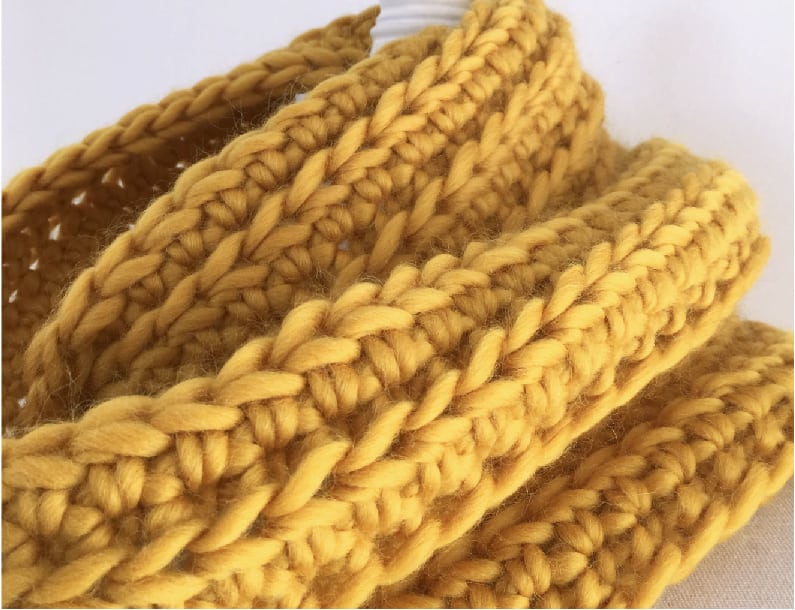
Welcome to the first of my ’all about crochet …’ series, where I will take a deep dive into the different approaches you can take to all kinds of crochet projects; from scarves, cowls and shawls, to hats, blankets and more.
For each project type I will look at construction methods, different styles and stitch sizes as well as how you can customise these to create your own unique project.
To begin with, I am takling all about one of the first things many crocheters make… scarves.
By the end of this article, you’ll know all about the different ways you can crochet a scarf, have a bunch of patterns to choose from and tons of guidance for your own ideas.
A simple crochet scarf is the classic beginner project, but this this humble wardrobe staple holds much more variation and interest than one might think on first glance.


The form and function of a crochet scarf
When I want to design a crochet scarf, or any other project for that matter, the first things I think about are form and function. That is; what do I want the item to do and how will it’s form (shape, drape and density) achieve that function?
As you read this article, or look at crochet patterns in general, it’s really worth bearing this idea of form and function in mind.
What is the function of a crochet scarf?
This might sound like a really obvious question. The answer is to keep your neck warm right?
Well yes.
But what else?
Maybe you want one that will keep your shoulders and chest covered up too. Maybe you’re looking for something lightweight to cover the back of your neck and shoulders in the heat of the day or as the day turns to night.
Maybe you want something you can drape over your head as well, to keep your ears warm, or something to wrap round and round and round for the extra cosy vibe.
Maybe you just want something that looks really pretty or cool or cosy.
Maybe you are looking for a present for a loved one (crochet scarves make a great gift!)
Maybe you’re a beginner crocheter and want something to practice your basic stitches, in which case, a scarf makes a great first project.
All of these are potential functions which can help you decide where to begin with crocheting a scarf and what features you want to include.
What would you choose?
How to construct a crochet scarf
Typically a crochet scarf is a simple rectangle – long and thin (relative to its length). The length allows the fabric to be wrapped around your neck to fulfil the function of keeping it warm.
That’s the basics.
But there are many variations. I outline some of the most common scarf types below and include basic schematics for each, as well as some images of examples. These can all be crocheted in rows along the long side or end to end.
5 common types of crochet scarf
Basic rectangular crochet scarf
This does what it says on the tin. A long and relatively thin (I’ll talk about sizing and proportion below) rectangle of crochet fabric to wrap around your neck.

The studio stripe scarf is an example of a simple textured rectangle scarf. The one pictured below was gifted to and loved by one of my brothers (I don’t think he was just being kind either!)

Crochet scarf with shaped or tapered ends
To add some interest, you may want to add shaping to the ends of your scarf. This could be some gentle tapering, or maybe some chevrons.
The schematic below shows tapered points as an example.

Key hole crochet scarves
A keyhole scarf has a hole towards one end which you can thread the other end through in order to fasten it securely.
This can be common in shorter scarves where you don’t always want long parts dangling down.

The Parade Keyhole Scarf / Wrap Pattern is a good example of this keyhole style.

Crochet infinity scarves
An infinity scarf is where the two ends of your rectangle are joined to create a continuous loop. The infinity scarf can be worn long or twisted over and worn as a double loop around your neck.

I’m a big fan of the infinity scarf – I cycle quite a bit and love not having to worry about ends coming loose! Below is my current favourite, the houndstooth forever infinity scarf (which is a free crochet pattern).

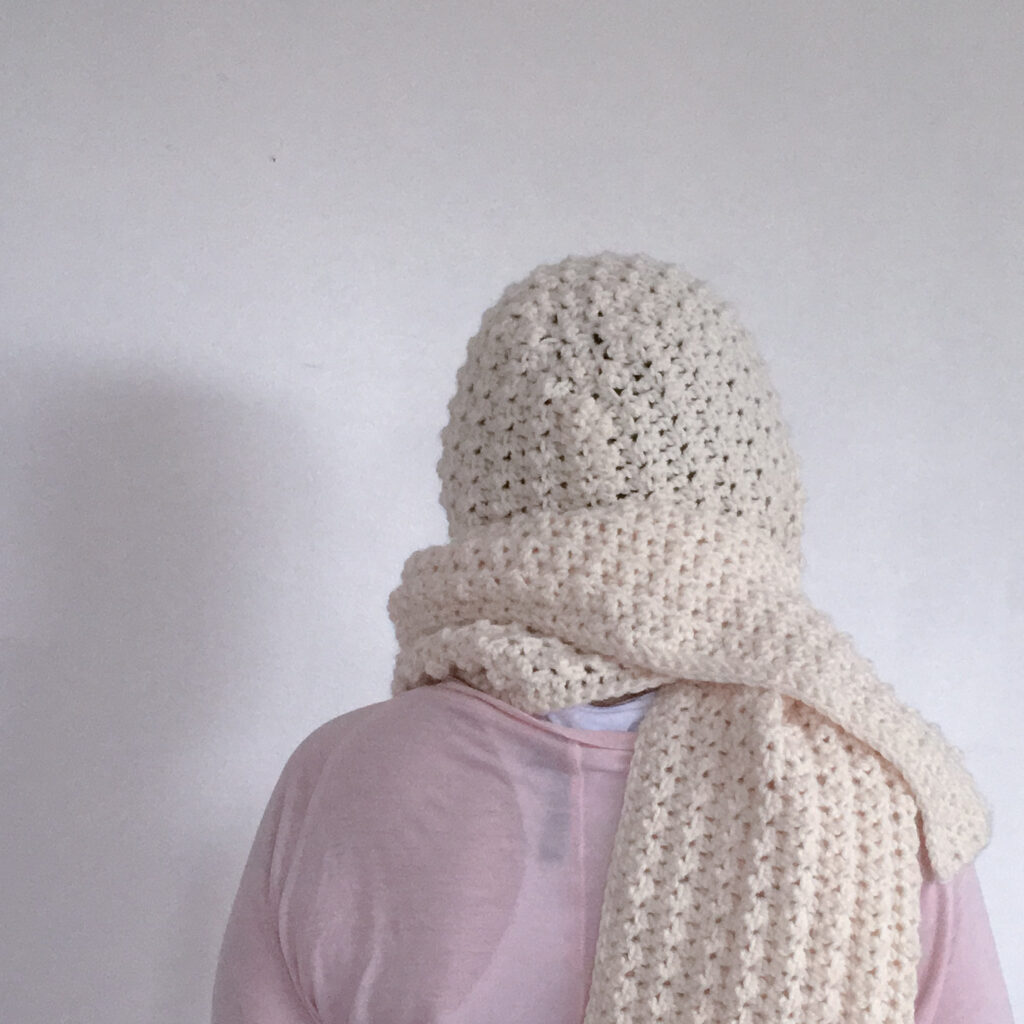
‘Scoodies’ – hooded scarves
The word scoodie is a mash up between the words scarf and hood… with an ‘ie’ on the end for good measure I suppose (or a likening to the word hoodie which seems kind of odd as there’s no sweater part… I digress!).
Typically, scoodies are made by folding a long rectangle scarf in half and running a short seam down the centre on one side to create a hood shape. The hood part is worn on the head whilst the long tails (for want of a better term) are wrapped around like a traditional scarf.
My slight bugbear with this approach is it creates a really pointy hood which isn’t always the form one is looking for. This is why I designed my studio scoodie (seen in the round up at the end) with a softer curve in the hood.

The studio scoodie adds some shaping to the back join section to create a greater curve at the back of the hood.
Crochet pocket scarves
A pocket scarf is simple a scarf with pockets on either end to keep your hands warm and or store your little nick nacks in.
I debated whether to include this because more commonly these have been better known as pocket shawls, where they sit around your shoulders rather than get wrapped around your neck. (I want to stick only to scarves in this post and not wander into cowls or shawls… that is coming!)
However, pocket shawls are a super popular modification of scarves so it would seem remiss and churlish not to include them!

How to crochet a scarf
So now that you know about the different shapes scarves might come in, lets look at how to approach crocheting them.
Scarves made in one piece
There are 4 main ways that you can crochet a scarf, and indeed any rectangular piece of fabric.
Firstly, and probably most commonly, you can crochet your scarf width ways in rows (from end to end), so that the length of each row represents the width of the scarf and the number or rows make up the length
Alternatively you can crochet your scarf lengthways, in long rows. So each row runs the full length of the scarf and the number of rows represent the width .
If you’re working in rows lengthways or end to end, you will generally start with a row chain stitches or a chainless foundation row of a suitable width then work your chosen stitch pattern until your scarf reaches your desired length or width.
Thirdly, and less commonly, you can crochet your scarf from corner to corner. When I speak about corner to corner, I mean technique rather than the corner to corner stitch. (I discuss the difference between the two here).
That said, if you want to crochet a basic scarf in the c2c stitch, you can learn how to crochet a corner to corner rectangle here and just adapt it to your chosen size.
Scarves made from motifs
You could also crochet a scarf using motifs such as granny squares, tessellated triangles or hexagons. All of the construction styles mentioned above can be worked with motifs, either joined as you go or made separately and sewn together.
My Mitred Minis scarf pattern is an example of a motif based scarf, this one uses mitred squares. You can make the scarf up from as many squares as you like, using the join as you go method, until you’re happy with the size and shape.

Construction, stretch and drape
When it comes to construction, one thing worth considering when choosing your approach is the amount of stretch you will get from your chosen stitch.
Depending on the specific stitch pattern, scarves crocheted width ways in short rows (relatively speaking) will generally stretch more than those crocheted lengthways. This is because crochet stitches typically stretch more between rows than stitches.
Scarves are generally all exposed to gravity as well as being pulled around a lot, so are likely to stretch more than many other crochet accessories. This, along with whether or not you choose to block your scarf is something you’ll also want to consider when thinking about the finished size of your scarf.
Which conveniently leads us on to…
What size should an adult crochet scarf be?
I often see people ask (in facebook groups and such) how big a crochet scarf should be.
And now we know about the importance of function… the quick answer is “as big as it needs to be!” But I appreciate that doesn’t help very much when you’re starting out!
So here is my guidance on crochet scarf sizes for adults (I do not address child sizing). I include a couple of quick tips for those of you with aversions to tape measures.
For clarity, this guidance is based on a combination of my own experience and other generic sizing resources from across the web.

How long should a crochet scarf be?
A typical scarf can vary in length from around 125cm/50in -200cm/80in. Or even up to 250cm/100in for super long scarves (think Tom Baker as Dr Who… *that* scarf!).
A short scarf can be as short as 100cm/40in but it’s unlikely this would stay wrapped around your neck as the ends would just not stay put. Adding a keyhole feature might help here.
Personally I would avoid making crochet scarves shorter than 150cm / 60inches, and longer is better as far as I’m concerned (up to around 2m where you start to move into double wrapping and super stretch territory).
Generally, infinity scarves can be a little shorter as the ends are attached to one another so you don’t need gravity to hold them in place. The length here will depend on how cosy you like them and how stretchy your stitch pattern is.
I like mine to be pretty cosy and stretchy, but I wouldn’t generally go for less than 110cm. (Though the fibre used also impacts this because some fibres are stretchier than others – there are never any straightforward answers in crochet… just lots of points to consider!)
Quick tip for scarf length: If you want a qiuick rule of thumb for scarf length, a good guide is to match the length of your arm span (from one wrist along your arm, across your back from shoulder to shoulder and down the other arm to your other wrist).
Alternatively you can use your (or the recipient’s) height. These two measurements are typically in the same ball park as one another so either should work as a rough guide.
How wide should a crochet scarf be?
Typically, most scarves measure around 15cm/6in to 25cm/10in wide.
I’m a fan of wide scarves because basically I’m always cold, but some people prefer thinner ones.
Again, stretch, stitch pattern and fibre will influence your choices here.
Another factor which can significantly influence width are stitch and row multiples.
Because the width tends to be relatively small, one stitch or row multiple either way may significantly impact the width of your scarf.
This is especially true if you’re working with super bulky yarn or a large pattern repeat. So do think about this when considering different crochet stitch patterns for your scarf.
These multiples also impact the length too, but are less of an issue because you tend to have more room to manoeuvre when it comes to length.
Quick tip for scarf width: If you’re not sure about how wide you want your scarf to be, making it around the same width as the length of your hand is a really neat little easy comparison.
How wide should your scarf be in proportion to it’s length
Although there are no hard and fast rules about proportion of width to length, I find that making the width of a scarf around 10-15% of the length usually works out well.
Often this is something you can eyeball – our brain knows when it ’looks about right’
Generally as the length increases the width should too. This is especially true for infinity scarves where an increase in width tends to shorten the length once double wrapped, so I would go for the narrower option here.
When does a scarf become a wrap or a shawl?
As your scarf gets wider, it begins to blur the lines between scarf and wrap. But where is that line and what is the difference between a scarf and a wrap anyway? (and where on earth to blanket scarves sit on the scale??)
I have thought about this a lot, and here’s where I have landed on the matter: Once you get past around 30cm in width I would say you’re into wrap territory.
But… there’s always a but. Some wraps are narrower than 30cm and some scarves wider, so what else makes the difference?
To my mind, the major difference is not the width, it’s that wraps are made to drape over the shoulders (more like a shawl), whereas scarves are meant to be worn close to the neck – either wrapped around or close fitting like a short keyhole scarf might be.
It’s all about that function thing again!
I don’t know if that’s an official definition (or if one exists) but it’s the one that works for me.
It also explains why I haven’t included any wrap patterns here. I am planning a separate post to discuss the construction of shawls and wraps, so won’t be going into anymore detail right now but will pop a link here when it’s done!

What’s the best yarn for a crochet scarf?
You can pretty much use any yarn and a suitable size crochet hook to make a scarf. The examples below range from super fine to super chunky yarns. You just need to work with a stitch pattern and size which suites your yarn.
If you’re a beginner crochet starting with your first scarf, I would say that a good yarn to use would be a medium worsted acrylic yarn with a 5.5 mm hook and simple stitches. Acrylic yarn is pretty robust, in expensive so if you go astray you can just pull it out and start again without an issue. Some more expensive yarns are difficult to frog (rip out) so I would save those until you have a little more confidence!
When choosing yarn for your scarf, think about how it’s going to be used (function function function…) Is it going to be facing the elements? In which case, wools and animal fibres can be super protective against the cold and wind (less so with the rain perhaps).
Will it need a lot of washing? In which case a superwash or acrylic may stand up better.
Are you making something elegant and full of drape? Then perhaps a silk or a cashmere may suit your needs better.
Is your scarf a lacy design to be worn in the heat? If so perhaps look at a plant fibre such as cotton, bamboo or linen, but don’t forget to think about how these might stretch with heavier stitch patterns.
These are just a few examples. Yarn choice for different requirements of a crochet project is a huge topic in itself, and a bit of an art form.
You may find this post useful which introduces what factors you need to consider when choosing or substituting a yarn in a project.
What crochet stitch is best for a scarf?
Stitch selection is another classic case of form following function. Like yarn choice it’s an art in itself and it’s part of the learning curve you go on as both a maker and designer.
To decide on a suitable stitch pattern, you’ll need to think about what you want your stitch pattern to do. Do you want something thick and cosy? Textured? Open and Lacy with lots of drape?
If you need some inspiration, you may want to look at these opaque crochet stitches (without all the holes), or some of my favourite cosy stitches.
If texture is your thing, this list of textured patterns made with post stitches will make super cosy scarves – though remember that you still want some drape in your fabric so that your scarf is comfy and hangs nicely. (you can learn all about drape here.)
If you just want a simple relaxing scarf to make, you could check out my top 5 mindful crochet stitches.
In each of these posts, I discuss what makes an opaque, cosy, textured or mindful stitch respectively, so it might spark some other ideas too.
The world really is your oyster when it comes to stitch patterns. Whatever you choose, it’s always worth making a swatch first to check you’re happy with how the fabric works up. It’s also always a good opportunity to experiment a little with crochet hook size.
Once you’ve chosen a stitch and a size, you may want a little help in calculating how many stitches and rows you need to work to achieve that size. If you want to get specific about it rather than wing it, this post explains how to calculate your stitch and row counts (spoiler; you’ll need to know your gauge/tension).
What embellishments look good on scarves?
Crochet scarves can feature all sorts of embellishments, wild or conservative.
Below is a list of the most common additions that can add beautiful finishing touches to any crochet scarf (as well as sometimes serving an additional sneaky function).
- Fringe on the short ends – this is a great way to avoid sewing in ends if you have a lot of colour changes as you can incorporate the tails into the fringe
- Pom poms on the corners or gathered ends – for a fun and playful vibe
- Tassels – look great on tapered scarves as well as on the corners of oversized scarves
- Pockets – are really popular at the moment and a great way to use your swatch (simply sew it onto the end of a scarf with a tapestry needle)
- Borders – adding a solid or lacy boarder to a scarf can add interest to simple designs, and in some cases helps reduce potential stretch
How long does it take to crochet a scarf?
The time it takes to crochet a scarf will depend on the yarn weight you’re using, the desired size of the scarf and the stitch size, complexity and density.
If you want a quick gift, you could crochet a simple scarf from super bulky yarn in under an hour (see the off the rails scarf below). You can also crochet an intricate scarf with sockweight yarn in more like 15 hours.
Oh, and your crochet speed will impact the time taken too.
My thoughts on time needed for any crochet project is that it doesn’t really matter how long it takes (unless you’re on a deadline), just enjoy the process!
More ‘all about crochet’ articles
If you’ve enjoyed this article, you might learn from some of my other deep dive ‘all about crochet…’ articles:
- All about crochet cowls
- All about crochet shawls and wraps
- All about crochet hats
- All about crochet cardigans
- Crochet garment construction
- Crochet sock construction
And with that indepth look at scarf style and construction, it’s time to have a look at some free crochet patterns which illustrate many of the different ways there are to crochet a scarf.

17 free crochet scarf patterns with different construction styles
I’ve tried to include scarf patterns to suit every skill level, with some using only beginner stitches and others using more intermediate or complex stitch patterns and shapes.
To make it easier to browse, I’ve broken the list down into some of the types of scarf and construction methods we’ve looked at throughout the article.
Basic crochet scarf patterns worked width wyas from one end to the other:
1. Filet crochet chevron scarf pattern
‘This way up’ is an easy, beginner friendly crochet scarf pattern with filet crochet chevrons of increasing widths.
It’s crocheted widthways from one end to the other, using a self striping yarn. It would also work really well in a solid yarn colour too, especially if you want to see more of the arrows.
It’s a is a satisfying, beginner friendly pattern and a great place to start if you want something not as plain as a basic stitch scarf.

(Oh and the PDF version includes a hat pattern too!)
2. Simple elegant textured scarf
The Bellevue Beautiful crochet scarf from Stitching together is a lovely textured crochet scarf worked in rows from end to end. It uses lyocell yarn which has the lovely sheen and you can just tell from the image how nice the drape looks.
It is a beginner-friendly scarf pattern which is is made from fairly simple stitches, mostly single crochets and chain stitches. This means that it should a be a nice and relaxing pattern to work.

3. Moss stitch crochet chevron scarf pattern
This crochet scarf, named ‘mixed signals’ after its colourway, uses an asymmetric chevron pattern to create a unique jagged effect.
The pattern uses one of my favourite stitches, the moss stitch, which is made up of single crochet stitches and chains.
The sample pictured uses a double knit bamboo cotton blend yarn, but it would work with most fibres. It has a fringe added for good measure (which you can see on the free pattern page).
I think this pattern it would look fabulous crocheted in a self striping yarn with long-ish colour changes. This is a good yarn substitution idea for anyone who loves stripes but wants to give their yarn needle a rest from sewing in ends!
It’s a great crochet pattern if you are looking to play with your own colour scheme or to try with your favourite yarns and lots of different colors.
This is a relatively simple pattern, but if you’re a crochet beginner, you may find stitch markers useful to mark the increases and decreases until you get used to the row repeats.

Easy crochet scarf patterns worked length ways (long rows):
4. Granny stipe scarf pattern with puff stitches
The free Granny Dot scarf pattern (with matching hat) mixes the classic granny stripe stitch with rows of brightly coloured puff stitches between to cheer up grey skies.
It’s worked lengthways (long rows) and is nice and long so you can create a rainbow of colours as you wrap it round yourself.
The different colour options make this a great stash-busting pattern or way to use mini skeins too.

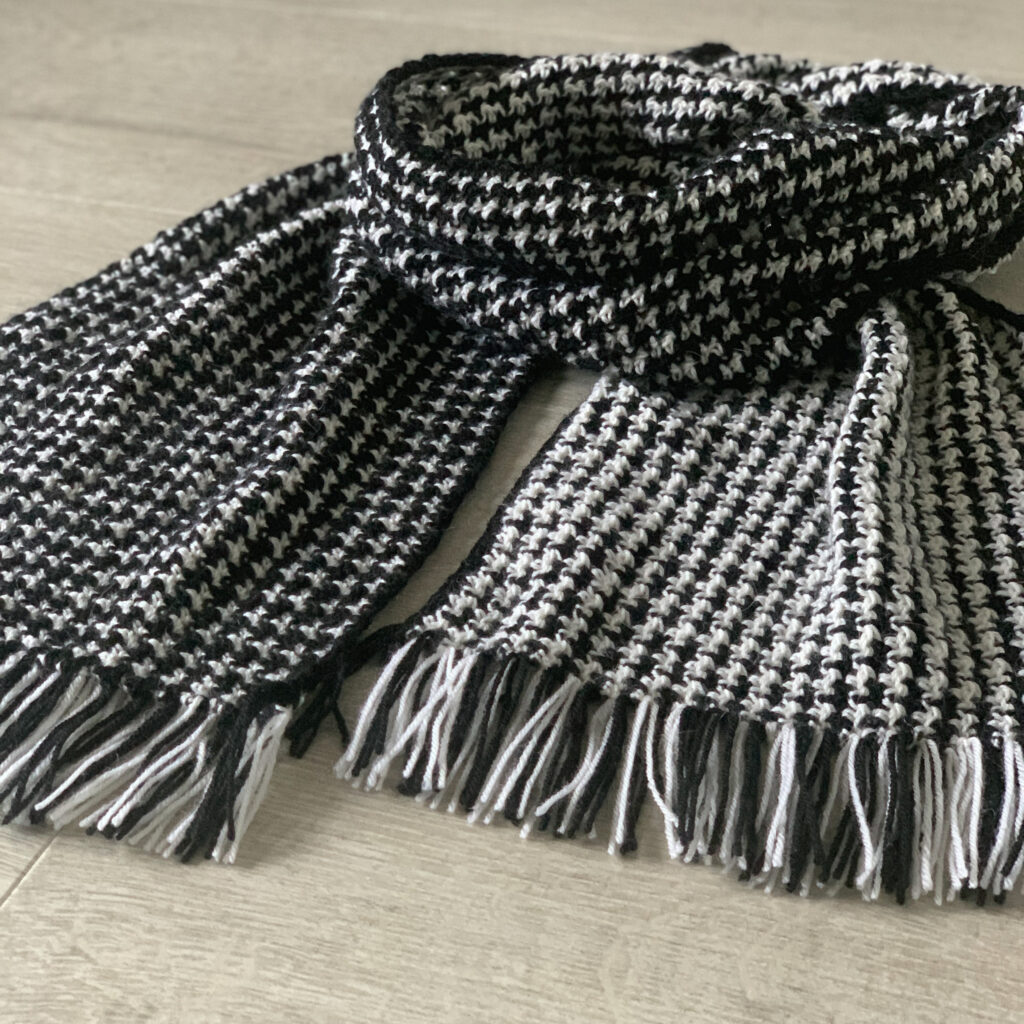
5. Houndstooth scarf with fringe
The hound hugs houndstooth scarf (aka dog tooth) is a simple crochet scarf pattern which uses a deceptively easy crochet stitch pattern made up mostly of single crochets and double crochets.
This version uses a long foundation row and is worked lengthways using sportweight yarn, so it is easy to adjust the width to suit as you crochet.
This design also gets over the need to sew in your ends by creating tassels on either end. One of my sneaky designer tricks!
6. Crochet bandanna scarf
The men’s crochet bandanna scarf from Blue Star Crochet is a simple ribbed scarf worked long ways with an interesting bandanna style chevron angle in the centre.
This feature adds some extra warmth around the neck, almost like a neckerchief. It has whispers of a shawl but is still wrapped around the neck, and is fairly slim in width, so is still a scarf in my book!
This style of scarf is a great idea for a gift for a man but it is a gender neutral unisex scarf pattern and can be worn by any adult.

Scarves with tapered or gathered ends:
7. Linked crochet sampler scarf with tassels
The ‘Expansions’ scarf pattern is a simple design worked from tapered end to tapered end with tassels attached. This a small scarf which is a great opportunity to learn a new crochet technique in linked stitches. You can find a written, photo and video tutorial for linked crochet stitches here.
It’s made using different heights of linked crochet stitches, making it a great project for practicing this technique.

Keyhole scarves
8. Elegant and simple keyhole scarf
The Winter Winds keyhole scarf from Sweet bee crochet is a small and perfectly formed keyhole scarf with some simple and effective patterning at the ends.
This is an elegant scarf with contemporary stitches that is perfect for that extra warmth under a jacket.

9. Hooded keyhole scarf
This free pattern from Hooked by Janet has it all going on; A tapered end with a keyhole style fastening and a hood.
If you like features on your scarf, this one is for you!

Infinity Scarves – looped crochet scarves
10. Super bulky quick crochet infinity scarf
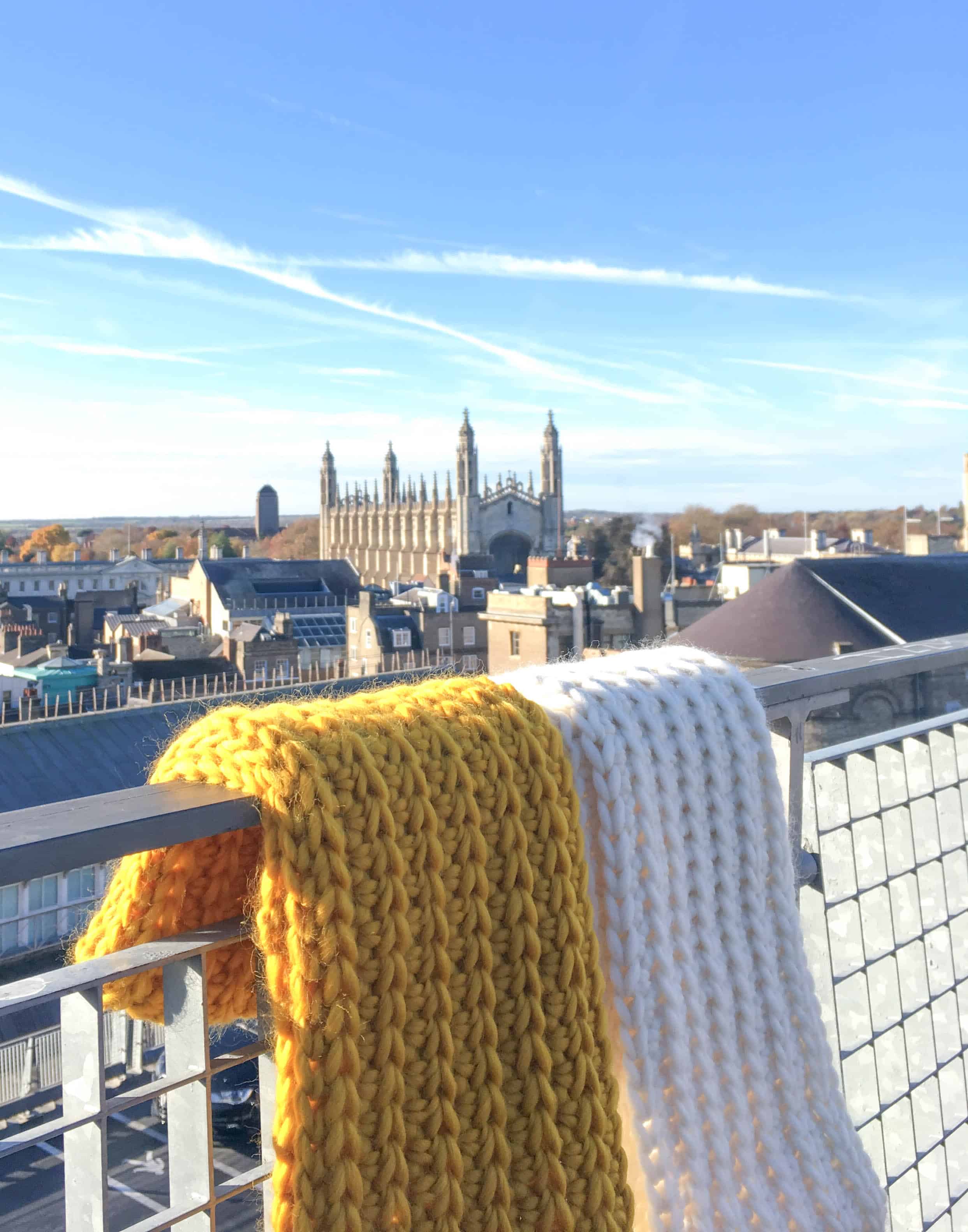
‘Off the rails’ is a super chunky, ribbed infinity scarf with a knitted look ribbing all around.
It’s a quick project using super bulky weight yarn that works up in an hour or so.
When you’re crocheting scarves with chunky yarn, you will need to make sure you choose a stitch pattern which has some drape so that the scarf moves and sits comfortably.
It uses simple stitches including singe crochet, half double crochet, slip stitches to join the rounds and works into the back loop.
If you prefer you can leave the ends unjoined and make it as an open scarf (you may want to add a few stitches to the foundation row to increase the length though).
These cosy infinity scarves are my absolute go-to if I’m looking for crochet gift ideas. They are quick and easy crochet patterns, look beautiful and keep you cosy through the winter months – what more could you want?
11. Textured cotton infinity scarf
The Sea Breeze infinity scarf pattern from Made by Gootie mixes a variety of textured stitches and colours to make a cheery accessory with lots of interest.
The one you see pictured uses cotton yarn, making it practical for transitional weather. It’s a really interesting pattern if you want to experiment with different stitches and textures.

12. Beginner tunisian crochet infinity scarf
The freestyler infinity scarf is a soft and comforting infinity scarf pattern with a little simple colourwork. It’s crocheted scarf made with bulky yarn, so it is a pretty quick crochet project.
It uses the Tunisian Simple stitch so is a good project to try if you want to experiment with Tunisian crochet. (You don’t need extensive experience with Tunisian for this one or any at all for that matter!)
Tunisian crochet does have a notorious habit of curling at the ends, but because you are joining the ends in a loop here, you don’t need to deal with that issue… problem solved.

Crochet scarves made from corner to corner
13. Oversized corner to corner patterned scarf with a fringe
I love this Nordic Crochet Super Scarf from Make and Do Crew. It’s crocheted using the classic corner to corner stitch with gorgeous colourwork pattern that makes me think of childhood snowball fights.
Not to mention that beautiful long fringe. I just want to dive into this one.
This is a great pattern if you’re looking to try corner to corner colorwork for the first time. The pattern includes a link to a photo tutorial showing how to read a c2c graph as well as a post on how to keep all your yarn balls under control when changing colours.

14. Corner to corner infinity scarf
Another crochet scarf pattern using the c2c stitch, is the easy infinity scarf from cosy Rosie.
It uses self striping yarn to create a simple but effective colour way. If lots of ends and switching colours in corner to corner isn’t your thing then this one might just fit the fulfil your chilled c2c needs.

15. Unusual diagonal ripple scarf
This beautiful Diagonal Ripple Scarf from A crocheted simplicity is for the crochet texture lovers who enjoy trying something a bit different.
At first glance, the gorgeous stitch pattern looks similar to my one step at a time wrap, but it uses a totally different and really interesting corner to corner construction method. It’s almost like making mitred squares and joining them as you go.
As always, Jennifer has a great step by step tutorial in the free pattern. It’s so satisfying to watch it grow!

Scoodies / hooded scarves
16. Textured scoodie pattern with rounded hood
The ‘studio scoodie’ is a variation on my studio stripe scarf with additions to create a rounded hood in the centre. As I alluded to earlier, no pointy hood bits here.
The scarf is worked length ways and the hood is worked as part of the last few rows. It’s a lovely textured stitch to work with and great for crocheters who may be looking to experiment a little with shaping.
If you love this texture, but want to keep it simple, check out the scarf only version of this pattern.
17. Tweedy crochet pocket scarf with zip pouches
I couldn’t resist adding this tweedy pocket scarf pattern from The loopy lamb to finish this round up.
I just love the bright colours and those awesome practical zip pockets on the end.
It’s not quite a wrap width ways and long enough to wind around your neck so, in my book that qualifies it as a scarf, even though pocket shawls are the common term. There was no way this one wasn’t making the cut!

I hope you’ve learned some useful tips and tricks from this post and found some inspiration for scarf season…
All third party designer’s images have been shared with their permission.
Please do share this post if you have crochet friends who might also learn a thing or two or find their perfect pattern from it!
Happy Hooking
Dx


