Shoulder shaping: how to add a shoulder slope to crochet garments

From the first time I designed a crochet garment, I’ve been on the look out for ways to improve the style and fit of my patterns. Adding a shoulder slope is one such approach.
It’s a simple shaping technique that can make a big difference to how a garment drapes.
In this article, I will explain what shoulder shaping / shoulder slopes are and how to add them to different types of crochet garments.
What is a shoulder slope?
Put simply, a shoulder slope is a downward slant that runs along the shoulders of a garment from the neckline to the outer edges of the shoulders. It aims to follow the natural line of your shoulders.
Below you see a cut out image of me wearing the Spin Off Tee (the tank version) which has a wide neckline so can be used to demonstrate the point.
I’ve added a dotted line horizontally across my shoulders at the outer edges. You can see that the point where my shoulders meet my neck is considerably higher than the dotted line. This is my shoulder slope.

Granted, it’s not an ideal front-on image with my arms relaxed, but it’s as close as I could find in my archives… In most of my pics I’m either standing sideways, hands on hips or playing with my hair! That aside, I think it illustrates the point – you can look at your own shoulder slopes in the mirror easily enough!
In this Youtube short I describe shoulder shaping in a bit more detail which may help you visualise it a little better – it helped that I was wearing a sweater dress with horizontal stripes when I filmed it (quite by accident)!
Why add shoulder shaping?
Adding shoulder slopes into a sweater or dress is a way to reduce excess fabric around the shoulders and upper arms to create a more tailored fit.
Any time a garment is shaped to follow the natural shape of your body, the effect will be a more fitted look.
Drop shoulder sweaters often have additional positive ease to allow a good coverage and nice drape. They are wider than the shoulder-to-shoulder measurement across the upper body because there is no shaping at the underarms, so you need to make sure the width accounts for this.
Adding angled shoulder slopes to drop shoulder sweaters helps the garment hang down more elegantly from the shoulders and reduces some of that excess fabric.
Shoulder shaping can be a relatively easy way to modify a very basic shaped garment for a disproportionately positive impact on fit.
How to add a shoulder slope
Shoulder shaping can be added to any style of crochet garment, but the approach varies with the construction style. You can learn more about different crochet garments constructions styles here.
Most commonly, shoulder slopes are made with short row shaping in panelled garments.
The Lark Sweater pattern uses short rows on both the front and back panels (see the unblocked pieces below), and the shoulder slopes are created by decreasing the stitch counts on the outside edges of the panels. The gentle slope descends from the neck out towards the edge of the shoulder. A simpler shoulder with no shaping would run in a straight, horizontal line.
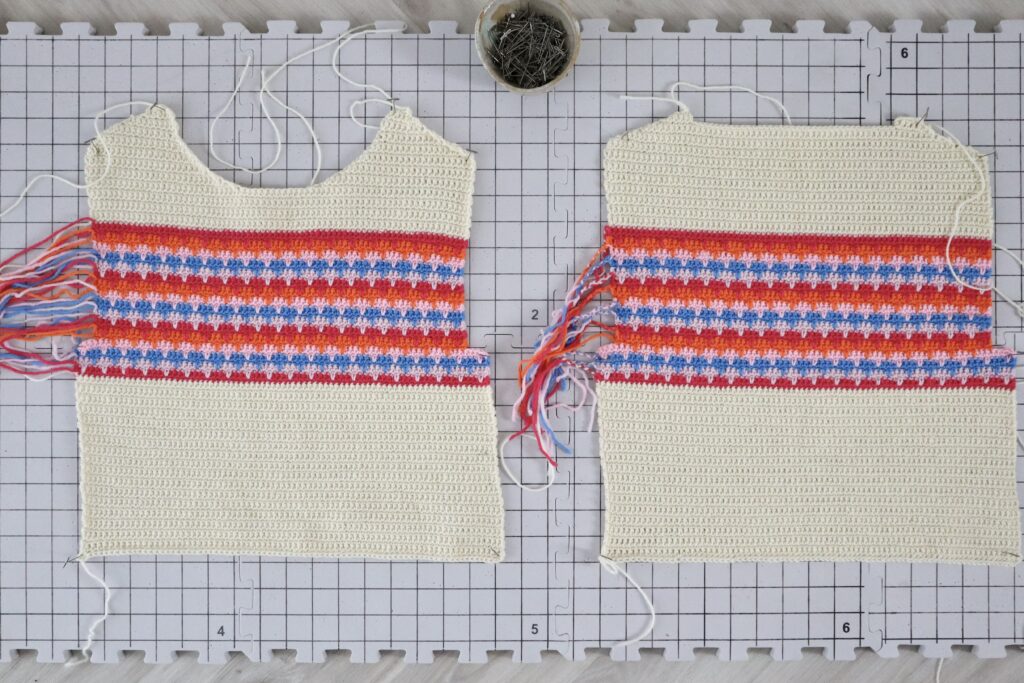
Because the pieces are unblocked and there is some curl in the fabric, the slopes look asymmetric, but they are the same on both sides on the front and back – this is the power of blocking!
This simple short row shaping approach is used in sweaters, vests and dresses and is relatively easy to apply.
In the ‘Squish It sweater’, which is more of a dolman design, I also added gentle shoulder shaping. With this design, the garment is worked side-to-side, so the sloping was made by increasing the length of the rows on one side of the neck and decreasing them on the other. It’s the same principle used in the neckline shaping.
As you see below, in the work-in-progress picture, this sweater is cropped and quite oversized. The shoulder slope just takes a little of the bulk from the upper arm without removing the cosy slouchy fit.

A word or warning. If you are adding shoulder slopes to a drop shoulder, and especially a modified drop shoulder sweater, you need to be aware that this will reduce the depth of the armhole. If you’re playing with this technique, make sure you take this into account.
When it comes to top-down yoke garments, such as raglans or round yoke sweaters, shoulder slopes are usually built in by design as part of the increase cadence. You can learn more about how top-down garments are designed in this article.
Below you see a progress picture of the round yoke of the Southern Pines Sweater. The yoke has been folded over and you see that there is a slope along where the top of the shoulders will go.

It is quite rare for a round yoke to fold into a perfect semicircle, so if you’re new to making them, don’t expect your yoke to lie flat before you fold and split it! (I dig into yoke based crochet garments here.)
Likewise, raglans shouldn’t really fold into a rectangle if you want shoulder shaping.
The image below shows the yoke of the Any Yarn Will Do cardigan in double knit yarn. It’s a v-neck cardigan and you see that when folded there is a slope in the shoulders.

How deep should a Shoulder Slope be?
Whilst designing the Lark Sweater, I really wanted to dig into shoulder shaping for panel garments. I particularly wanted to know if shoulder slope depth changed with different sizes or was a fixed measurement.
Whilst I could not find any definitive guidance, the consensus seems to be that the shoulder slope ranges from 2.5-4cm / 1-1.75 inches and is fixed across sizes.
Of course we are all different shapes and sizes and I encourage you to measure your own shoulder slope (with a spirit level and a ruler perhaps?) to see how deep your own shaping runs.
The slope applied to a garment will also vary depending on the width of the neckline. For example; a garment whose shoulder width comes right up to the side of the neck will have more slope than one with a narrow shoulder and wide neckline.
The spin off top pictured above, which has no sloping at the narrow shoulders. Even after extolling the virtues of shoulder shaping, I don’t really think this design needs it because of the wide neckline, narrow shoulders and the capped sleeves which have their own shaping.
As always ‘it depends’ is the most realistic answer to the necessity and extent of shaping you might want to add at the shoulders.
I hope you have found this whistle stop tour of shoulder slopes informative. I talk through how I added shoulder shaping to the Lark sweater in my latest Crochet Studio Sessions podcast, so do have a look at that if you like the visuals,
If you’ve got any questions on this topic, please do drop them in the comments and I’ll do my best to answer them – note that all comments are held for moderation so if it disappears, it will just be waiting for me to review it!
You can also find more crochet design tips here and learn more about crochet garments in my ‘my crochet wardrobe’ articles.
And for now
Happy Hooking
Dx

Copyright Dora Does Limited, Registered in England, Company Number 13992263. This pattern is for personal use only and may not be shared or reproduced in written, photo, video or any other form without prior written consent. All rights reserved. Terms of service.