How to add crochet ribbing for an easy hat brim, cuff or hem

Adding ribbing to the bottom of your crochet project, whether it’s a hat, sleeve or sweater, can create a neat, professional finished look as well as adding a functional stretch into the crocheted fabric.
This post will teach you a quick and easy way to make join-as-you-go crochet ribbing to the end of a hat, cuff, scarf or other crochet project.
You will also learn how to start a project with a rib stitch, including how to crochet into it.
Types of crochet ribbing stitch
Throughout this tutorial I will use a simple type of ribbing, crocheting simple stitches into the back loop only.
This style of crochet rib is popular because it creates a knit-look stitch, but there are many different ways to work crochet ribbing, many of which can be substituted for the type used in the examples below.
If you’re a beginner crocheter, you might like to start with this simple crochet ribbing stitch, which demonstrates how to make a quick and easy ribbed ear warmer.
If you’ve made ribbed stitches before and are looking to explore other ribbing styles, you may want to browse my crochet rib stitch directory. Part 1 of the crochet ribbing directory looks at rib stitches made by working in different loops and slip stitching. Part 2 of the crochet rib stitch directory looks at ribbing using post stitches. It also explains the important difference between vertical and horizontal crochet rib stitches.

When to add crochet ribbing to a project
Crochet rib stitches can be used in a huge variety of ways.
There are crochet patterns which use rib stitches throughout the whole design, such as the off the rails infinity scarf, the winter solstice dress or the fisherman’s winter beanie. But the most common use of crochet ribbing is probably to add a feature ribbed edge to a project.
You might want to add a brim to your crochet hats, such as the studio beanie set or the off piste or scandi stash buster beanies. You may also use the technique to create a cuff, a hem or roll neck on a sweater – all three are used in the cozy up sweater.
I’ve also used crochet ribbing to create a pocket on a cardigan, cuffs on socks and texture on a pillow. It really can be used in endless ways.
One of the key things to consider when adding ribbing to your crochet projects is whether it is used just for the look and texture or for the function it serves as well. This post about ribbing goes into a lot more detail about that, but it’s something worth bearing in mind when using rib stitches in a crochet project.
In the examples below I use simple back loop crochet rib stitches which have a little stretch and elasticity, so are suitable for hat bands (or hat brims if you prefer), cuffs and hems. Other types of ribbing may not work in the same way.
How to add crochet ribbing to the bottom of a project
I’ll start with demonstrating how to add a single crochet back loop rib stitch to create the brim of a hat with a written description and video tutorial. I’ll follow this with illustrating top down ribbing using half double crochets.
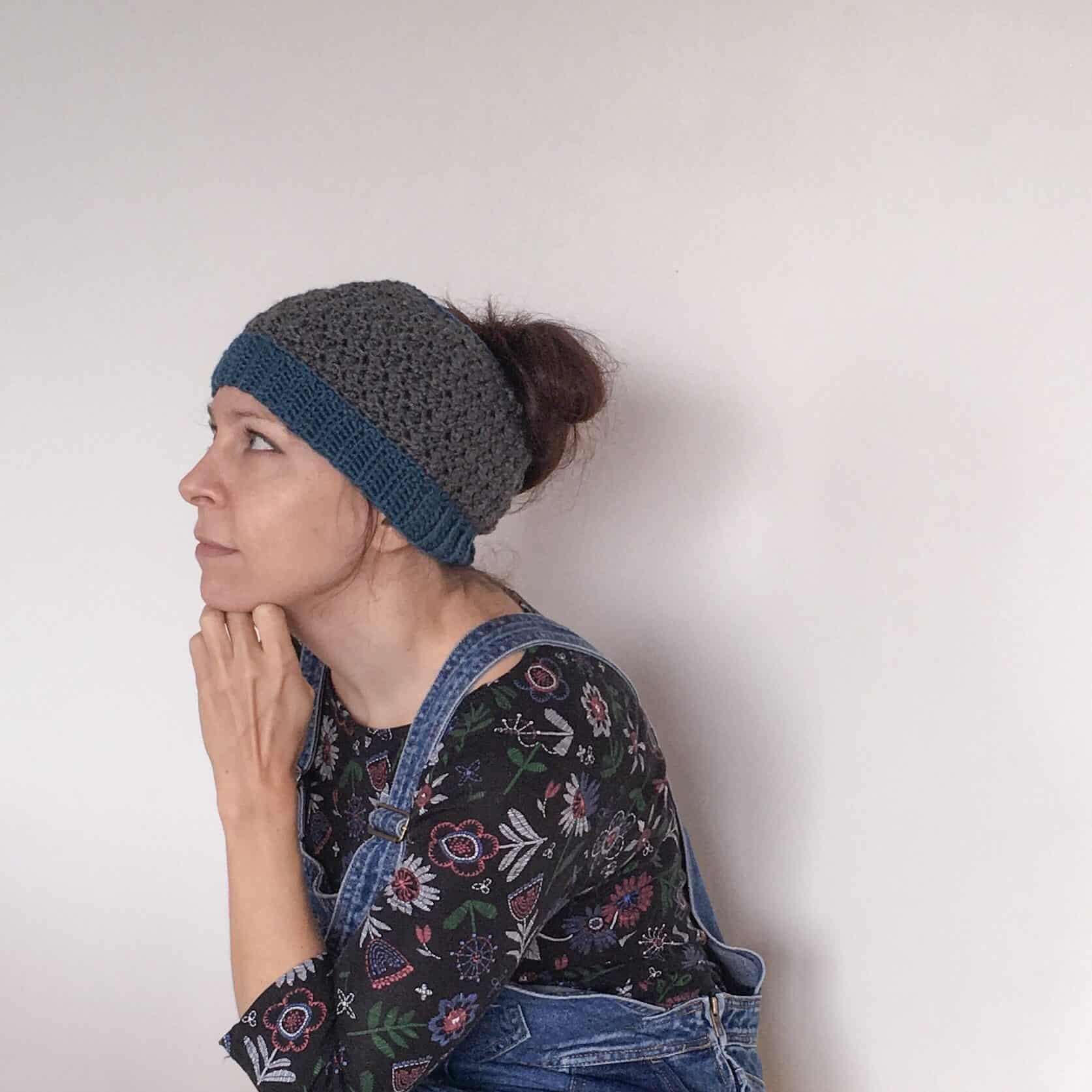
I have a pattern accessories collection called the ‘studio’ range, which currently includes The Studio Scoodie and The Studio Stripe Scarf (free pattern) and a the Studio beanie hat pattern (pictured throughout this post) which includes three hat style variations.
When it came to adding the ribbed brim or hat band to the messy bun hat version I had a bit of a flash back to when I was learning to crochet. I remembered how those ribbed bands on hats, like the one below, looked like they were so complicated and something I would never be able to achieve.

Well I’ll let you into a secret… they are easy peasy!
I decided I wanted to stop any of you having that same sense of intimidation I had so put together this tutorial, which I have added to since the original version.
How to crochet an easy ribbed hat brim – video tutorial
The YouTube tutorial below shows you how to add a single crochet ribbed brim to a hat.
The video uses the Studio Bun Hat to demonstrate the technique, but the same approach can be used with pretty much any hat pattern which is worked top down.
Note that this video is left handed – if you are right handed, you will work in the opposite direction / mirror image (this post explains the difference between left and right handed crochet).
Written instructions for single crochet ribbing
Below are the instructions which accompany the above video which uses the following abbreviations, in US crochet terms; stitch(es) (st(s)), chain (ch), single crochet (sc), slip stitch (ss), back loop only (blo), right side (RS) and wrong side (WS).
Round 1 (RS): Ch1, sc in each st around the base of the hat, ss to top of first st, turn. 64 sts
Turn to work at right angles to the base of the hat.
Row 1 (WS): Ch8, 1sc in second ch from hook and next 6 ch, ss into each of the first and second sts on Round 1, turn. 7 sc and 2 ss
Row 2: Do not chain, sk 2 ss, 1sc in blo of each sc to end, turn. 7 sc
Row 3: Ch1, 1sc in blo of each st to end, ss into next 2 sts on Round 1, turn. 7 sc and 2 ss
Repeat rows 2 and 3 around the base of the hat until you have worked into the last sc on Round 1.
To join the two sides of the brim, slip stitch through the back loop of each sc on the last row worked and the back loop of the corresponding chain of the ch8 made at the start.
This post shares more about crocheting into chains if that’s something you struggle with.
You will see that the ribbing pulls in a little to create a tighter tension than the rest of the hat. This is intentional. The brim should have negative ease so that it stretches to fit your head and keeps the hat in place.
The hat band in this video measures just under 2 inches / 5cm, but this can be easily changed by increasing the number of stitches in the starting chain and in each subsequent row.
That’s it. It’s such a simple technique, a great thing to have in your tool box and it’s quick and easy to learn.

How to add crochet ribbing to a project
The instructions below teach you how to add ribbing to the end of any project, using half double crochets worked in the back loops only. This is one of the most common ways to easily incorporate ribbing into crochet projects.
In the examples below I have used worsted weight yarn and a 5mm crochet hook, but the technique will work with a variety of yarn weights and a suitable size crochet hook.

The image above shows a circular piece of crochet fabric, designed to emulate the end of a sweater sleeve. I have added crochet ribbing to the final round of the sleeve to create a cuff which pulls the fabric in a little to add some shaping.
How to add half double crochet ribbing – simple written instructions
The instructions below show you how to add a half double crochet ribbed edge to the end of any project.
I have started with the final round of the sleeve in this example, but you can also work this into any existing row or round of stitches or the back of a starting chain. Whatever your crochet project presents you with, I refer to this as the ‘anchor’ row or round.
I used 7 stitches for the ribbing depth but you can alter this by changing the number of stitches in the starting chain and the subsequent stitch count accordingly. The principle is the same as the single crochet ribbing described above, with a few subtle differences.
The instructions are written in US terms using the following stitches and abbreviations (in US terms); chain (ch), single crochet (sc), slip stitch (ss), half double crochet (hdc), back loop only (blo), skip (sk), right side (RS) and wrong side (WS). Stitch counts are given at the end of each row and turning chains do not count as a stitch.
Round 1 (RS): Ch1, work a round of sc around to end, join to top of first st with a ss, turn (the anchor round).
Continue at right angles to Round 1 and switch to work in rows;
Row 1: Ch8, 1hdc in 2nd ch from hook and next 7 ch, ss into next 3 sts on Round 1, turn. 7 hdc, 3 ss
Row 2: Do not chain, sk 3 ss, 1hdc in blo of next 7 sts, turn. 7 hdc
Row 3: Ch1, 1hdc in blo of next 7 sts, ss into next 3 sts on Round 1, turn. 7 hdc, 3 ss
Repeat rows 2 and 3 until both sides of the cuff meet. To join each side, ss into blo of last row of hdc and blo of corresponding starting chain.
Note that on the last row repeat, you may need to ss into 2 or 4 sts (instead of 3) on round 1 to work into all stitches. This will depend on how many stitches you started with in your anchor row or round.
I work a chain 1 to go with the half double crochet to help stop the ribbing stretching out of shape, but if you’re looking for a ribbing with more stretch you can start Row 3 repeats with a chain 2.
The number of stitches you slip stitch into will determine the tension of the ribbing. If you slip stitch into more stitches on Round 1 then your ribbing will have a tighter tension and pull in the fabric it’s joined to more tightly.
If you slip stitch into less stitches on round 1, your ribbing will be more relaxed.
I call this top down ribbing, because you are working into an existing project which typically involves working into the end. You could also use the same technique to work a collar into the neckline of a sweater, in which case you would, strictly speaking, be working bottom up, but lets not get too bogged down in semantics!
How to start a crochet project with a rib stitch
The below tutorial will show you how to crochet a length of ribbing and to start working into the row ends. I call this technique bottom up as it is often used to start a project.
For example, you could work this as a brim and work the rest of the hat upwards, or a cuff and work from the sleeve to the shoulder. The image below shows a swatch where the ribbing was created and then rows were worked at right angles into the row ends in the oatmeal coloured yarn. You might use this approach if crocheting a cuff and working a sleeve from the wrist up to a shoulder for example.

Written instructions to start a project with ribbing
The instructions are written in US terms using the following stitches and abbreviations; chain (ch), single crochet (sc), slip stitch (ss), half double crochet (hdc), back loop only (blo), skip (sk), right side (RS) and wrong side (WS).
Stitch counts are given at the end of each row and turning chains do not count as a stitch. Once again I have used a rib 7 stitches deep but you can adjust this to meet your preference.
Rib section:
Row 1: Ch8, 1hdc in second ch from hook and the next 6 ch, turn. 7 hdc
Row 2: Ch1, 1hdc in each st to end
Repeat row 2 until your ribbing reaches the desired length. (You can join to form a loop if desired.)
Working into the row ends of the rib:
This is where I have changed colour in the image above.
Row 1: Ch1, work a row of single crochets across the row ends of the ribbing, turn. When working with hdc I work 3 hdc for every 2 row ends across. This achieves the tension as shown in the image above. I work 2sc into one row end and 1sc into the next and repeat across the row.
Row 2: work in your chosen crochet stitch pattern into the sc row for the rest of your project. In the image above I have worked rows of double crochet after the single crochet row.
In a similar manner to changing the number of slip stitches to change the tension with top down ribbing, here you can change the number of stitches you work into row ends with this bottom up ribbing.
If you work more stitches into row ends, you will start to create a ruffle and have more fabric in the pattern part than the rib part. If you work fewer stitches into the row ends then the rib section will be looser than the pattern section.
You can use this method with any kind of rib stitch and change the cadence of how you crochet into the row-ends to an appropriate rate.
It is useful to understand how to change the tension of the ribbing so you can customise it to meet your preferences.
As with the top down technique you can work downwards (again using the example of a sweater where you may start with a ribbed neckline and work down from there. The term is mainly used to indicate that you are starting with ribbing.
Using crochet ribbing with garments – video lesson
In the videos below, you will see a demonstration of both the top down and bottom up methods of adding crochet ribbing. This video was originally created for the ‘crochet garments with confidence’ summit and has lots of other useful tips relating to crochet ribbing given throughout.
Adding crochet ribbing – right handed
Adding crochet ribbing – left handed
Crochet Ribbing Hints, Tips and FAQs
How deep should your crochet ribbing be?
This will depend on the function its serves. If you’re adding ribbing to the base of a hat ro create a brim, you will need to take the overall length of the hat into account. You will also need to decide whether you want to fold the brim over itself, over the base of the hat or leave it unfolded.
Think about and decide how you want the ribbing to look and function before adding it.
To change the length of your crochet rib stitch, you simply alter the number of stitches in the starting chain and subsequent rows. It really is as simple as that.
Does this technique work with any crochet rib stitch?
This technique can be used with any crochet rib stitch which is worked vertically. That is the stitches equate to the depth of the ribbing and the number of rows to the width.
You will need to change the slip stitch cadence (as described below) for different stitches.
If you want to see more ribbed crochet stitches, check out my directory of ribbed crochet stitches, part 1 (back loops and slip stitches) and part 2 (post stitch ribbing).
How do I change the tension of crochet ribbing?
One of the common ways to make crochet ribbing tighter is to change the hook size from that used in the rest of your project. Many people like to move down to a smaller crochet hook for a neater, more dense crochet rib. But equally you could try working with a larger hook.
The second way to change the tension, which can have a larger impact than hook size, is to change how often the rib is joined to the body of the project.
The number of stitches you slip stitch into (for top down ribbing) or the number of stitches you work per row end (for bottom up crochet) will depend on a number of factors but overall the cadence is the same for top down and bottom up if you want to achieve the same tension.
This is my rule of thumb for creating ribbing with basic stitches:
Slip stitch back loop rib stitches: slip stitch into one stitch on the anchor round for top-down, work 1 stitch for every 2 rows-ends for bottom up.
Single crochet back loop rib stitches: slip stitch into two stitches on the anchor round for top-down, work 1 stitch into each row-end for bottom up.
Half double crochet back loop rib stitches: slip stitch into three stitches on the anchor round for top down, work 3 stitches into every 2 row-ends for bottom up.
Half double crochet back loop relaxed ribbing: For a more relaxed version of hdc blo rib stitches, alternate between slip stitching into two and then three stitches on the anchor round for top down. For bottom up, work 5 stitches for each 4 row-ends. This creates a tension similar to rows of double crochet so will not pull the shape in.
Double crochet back loop rib stitches: slip stitch into four stitches on the anchor round for top-down, work 2 stitches into each row end for bottom up. Note that you may start to notice small holes appear in the top down version of this ribbing so use with caution!
How can I hide the join at the ends of the crochet ribbing?
There are many ways to join the ends of ribbing that has been worked in back loops.
Although working into the back loop of the final row and the back loop of the starting chain is a common one, there are other ways to make it look more seamless. It will depend whether you end on a wrong or right side and the style of crochet ribbing you are working with.
If you’re joining on the wrong side of your crochet rib, you may want to try crocheting into the front loop of the stitches on the final row and the front loop of the corresponding starting chain. This creates a little rib on the right side of the work which makes the join look very discrete.
If in doubt, get curious and play with different joining methods to see what works best for your project!

I hope you have found this a useful guide to adding crochet ribbing. If so, do save it to your favourites for your next project, share with your crochet friends or save to Pinterest.
And if you have any more questions about using ribbing in crochet projects, just drop a comment below and I’ll do my best to answer it!
Happy Hooking
Dx


This is great!! Your presentation for the summit was so informative and helped me understand ribbing so much better.
Thank You!
You’re welcome! I’m so glad it helped you with your crochet ribbing game! 🙂
Thank you for the video – it was quite hard to distinguish the stitches, I know it was because of the beanie colours you were making but a contrast would be easier to follow. I learnt this technique from another crocheter (if that’s the word) and it varies slightly in that you do a single chain on the turn nearest the hat as well and a full sc in the last stitch at the edge end for stability but whatever it’s a great technique and looks and feels good.
Thank you. This was one of the first videos I made because I love the technique – I tend to use lighter yarns these days. There are lots of variations on the turning chain. My preference is that the turning chain doesn’t count as a stitch whereas I know others prefer to work the opposite way. It’s a personal choice thing really 🙂
Are you left handed, Dora, ambidextrous or right handed but needed to use your left hand for this particular technique? I apologise if this sounds daft, but I could well be using this with my next sweater attempt and giving myself extra grief trying to use my left hand when I am right handed.
Hi, Not a daft question at all! I am left handed. I need to go through my posts and add a note indicating which ones are left handed and which ones I have flipped to right handed (which I have started doing now!). So if you’re right handed, just mirror what you see here!