How to construct a modified drop crochet sweater
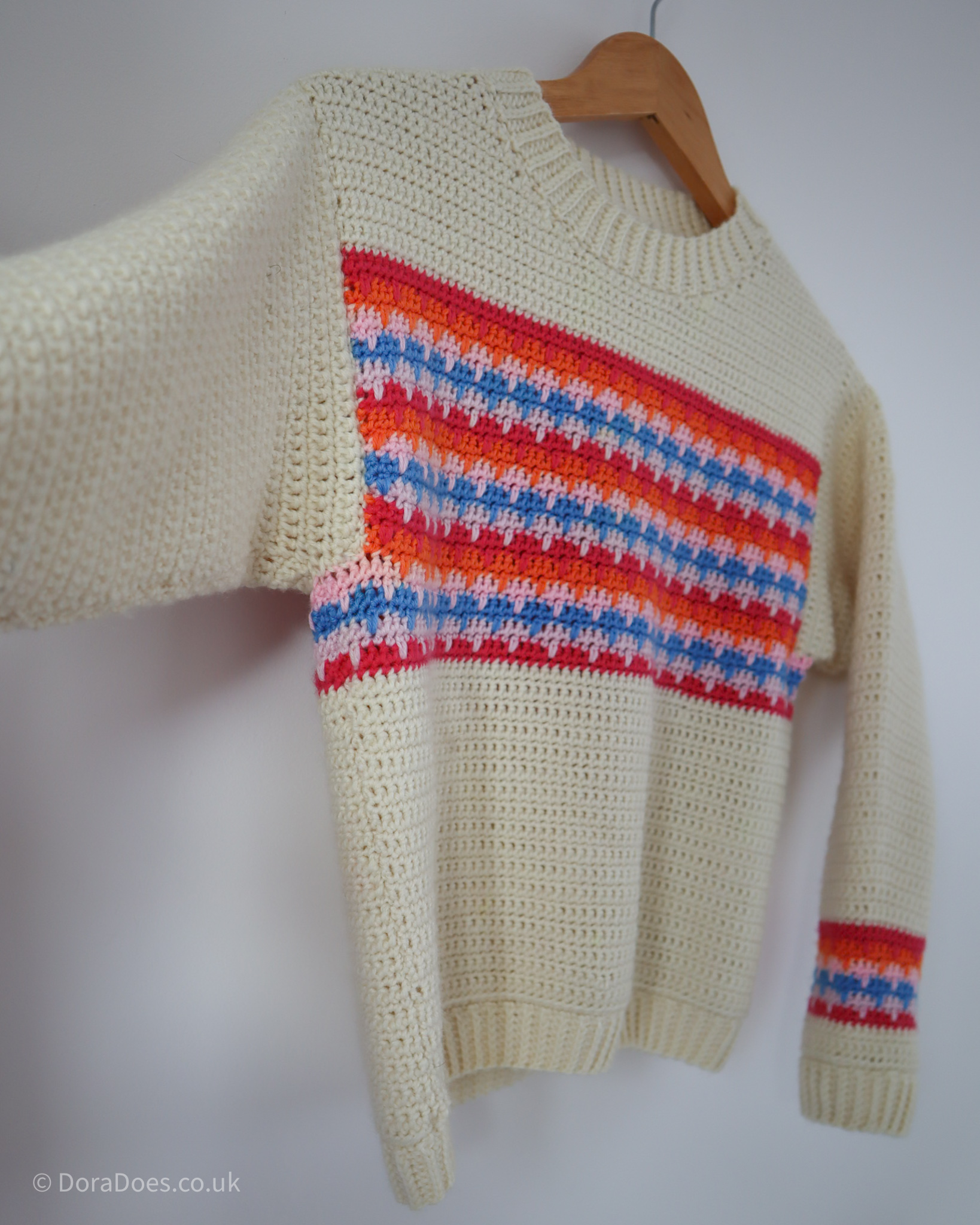
This year I’ve rediscovered my love of the detail behind crochet garment construction (and explaining it). So in today’s post, I am going to share my guide to the modified drop crochet sweater.
This tutorial includes both a written description of the modified drop design, construction and variations as well as a video tutorial which shows the process of the construction.
Here’s what you’ll find:
This post is a natural follow on from my earlier and equivalent tutorial on how to construct a simple drop shoulder sweater.
Note that this isn’t a guide to designing modified drop sweaters as such, but it does explain the shaping and why its makes a difference. So if you do like to freestyle your crochet garments, then you’ll learn what to think about!
(You might also want to check out my ‘how to crochet to measure’ tutorial to learn the basic math involved in design.)
If you’re totally new to crocheting garments then I encourage you to start with my article explaining the basic types of crochet garment construction that are used most commonly in crochet patterns. This will give you a good overview of the options available for crochet garments.
Okay, with the intro and pre-reads out the way, let’s take a look at modified drop crochet sweater construction.
What is a modified drop crochet sweater?
The modified drop construction style is a simple variation on the modified drop style, where notches are cut out of the armhole for the sleeves to slot in. This gives the sweater a more fitted silhouette.
This construction style is offers some of the advantages of a set-in sleeve design but without the complexities, maths and sleeve easing often involved with a set-in sleeve design.
With the east modified drop, the ‘cut out’ or notch will form an L-shape which the top of the sleeves should slot in easily. You will still have the structural support that the seaming close to the shoulders offers, but will be sewing in straight lines!
Below you can see a basic schematic showing a typical modified drop sweater. The dotted pink lines show how the notch is made around the armholes and how the sleeves fit directly into that notch.


The depth / width of the notch will depend on the size you are making. To calculate how much you want to cut out of each side of the body panels, you deduct the shoulder to shoulder measurement from the chest width and divide the result by two.
Let’s say your chest width (under the armholes) is 50cm across, and you want the sweater to measure 40cm from shoulder to shoulder (I’ve picked these numbers out of the air – make sure you measure yourself).
To calculate the measurement you need to bind off (cut out) at the underarm you would do the following sum: (50-40)/2 =5cm
So the overall difference between the body and shoulder widths is 10cm and you divide that by 2 to give you 5 cm each side. You can use this method with your gauge to work out how many stitches that is (or rows if you’re working side to side).
The top section of the sleeve, where there are no increases / decreases should also be the same length as the bind off width (possibly more depending on how you want to shape your sleeves) so that it slots into the cut out of the armhole shaping.
These flat sections on the outer edges of the sleeve are essentially a super basic sleeve cap. On the diagram above you can see the pink dotted lines around the armholes echoed on the top of the sleeve panel.
When looking at measurements for the sleeves on a modified drop pattern, take care to note the difference in the underarm length – which runs from the wrist to where the sleeve meets the body at the underarm – and the wrist to shoulder length – which runs from the wrist to where the sleeve meets the shoulder seam. The latter will be longer than the former.
When folded, the top of the sleeve cap should be the same length as the underarm depth of the body to ensure a good fit.
How to join the panels in a modified drop sweater
Below you will see a simple joining schematic for a basic modified drop design – the pink lines highlight some of the key joining seams.

You will start by seaming the shoulders together, with the panels laid out flat. Make sure the relative wrong and right sides are facing the same way.
Once the shoulders are seamed, you can slot the sleeves in and join them around the sleeve cap – so sew together the flat edge at the top of the sleeve to the horizontal part of the notch, then sew up the armholes and repeat on the other side’s notch.
Once the sleeves are in place, you can fold the sweater along the shoulder line and sew together the side seams and underarms. I use the mattress stitch for seaming this style of garment.
Once all the seaming is done, you can add any finishing touches like collars, hems and cuffs etc. Although it is possible to make some of these, such as the hem and cuffs, before the panels are seamed, I prefer to wait until afterwards.
And that’s really all there is to it – super simple!
Video guide to constructing a modified drop sweater
You can find a video tutorial which walks you through the construction of a modified drop sweater on YouTube or watch below:
Variations on the modified drop sweater
Just like most styles of garment construction, you can modify the details to customise your specific design. The principle of how the sleeves and body interact will remain the same, but you can add shaping elsewhere to further refine the design.
Below I share a couple of examples of style adjustments you can make to the modified drop design.
In the video tutorial, I used the Crochet Lark Sweater Pattern to demonstrate the joining process. This crochet sweater design has a slightly different shaping to the basic modified drop described above.
Whilst it still has that notched underarm shaping that defines the modified drop, it also has shoulder slopes and the sleeve shapes are a little different.
The shoulder slopes make the underarm depth a little shorter (meaning even less excess fabric around the shoulders) and the sleeve shaping is adjusted so that the sleeve slopes on the top of the arm rather than underneath (which gives a more flowing shape to the top line of the sweater).
I talk about this sleeve shaping technique in my studio sessions podcast – it’s a bit of a game changer for me!
Below is the joining schematic for the Lark Sweater. You might find it useful to compare it with the basic joining schematic above – it’s the same but different.

Below is another alternative way you might construct a modified drop design. No fancy shaping here, but a different way to see the panels. This time in a cardigan pattern.
This is a template from the schematic for the Got your six cardigan which is made of one single body panel with two sleeve panels. The gaps between the fronts and back shoulder section marking it out as a modified drop design.

When you fold those fronts over, you end up with a horizontal notch at the underarm that the sleeves will slot neatly into. It’s as simple as the basic design in principle, but looks pretty different from when you have separate panels laid out.
These are just a couple of different ways that the modified drop shaping can be applied to different garment patterns.
Designing the Lark sweater and revisiting the modified drop style has reminded me what a great, versatile approach this is.
The blunt geometric shaping means that working with stitch multiples isn’t too complicated and the fitted look you can achieve in a really simple way is such a great payoff! It really does offer the best of both worlds!
Examples of modified drop crochet sweater patterns
Now that I have hopefully spread my enthusiasm for the modified drop style of crochet sweater, you will be raring to give it a go!
Here are a few crochet garment patterns which all use the modified drop construction method.
An intermediate colourwork sweater that you can go bold and bright or cool and tonal with.

You get two for one here. The Tribute pattern is worked top down and can be made either into a sweater or carry on and create a dress (with hip shaping thrown in to boot!) It’s a fun 60s vintage feel design that has a nod to the on-trend filet crochet technique too.

An early design of mine that uses the classic moss stitch to create a comfy long cardigan. The subtle modified drop element helping it not to feel too oversized on the shoulders. And it has pockets obvs.

A textured crochet cardigan that feels cosy and a little oversized but stays comfortably put when you wear it. This one comes with two length options and is made with Aran weight yarn and simple stitches. It’s a free pattern too 🙂

This textured men’s sweater pattern from A Crocheted Simplicity demonstrates how great textured stitches can look with the modified drop construction.

Tunisian modified drop anyone?
If you’re looking for something a little different and like your crochet Tunisian, this free modified drop Tunisian crochet sweater pattern from Andrea Crete uses fingering weight yarn and has a gorgeous texture and includes some great techniques to try.

I hope this deep dive and pattern suggestions have given you some inspiration to try your next garment!
And, as always, if you have any questions or feedback, please do drop them in the comments. You may not be able to see your comment right away as everything is held for moderation but I do answer all comments!
Happy Hooking
D
Crochet Clothing Tips and Techniques
Copyright Dora Does Limited, Registered in England, Company Number 13992263. This pattern is for personal use only and may not be shared or reproduced in written, photo, video or any other form without prior written consent. All rights reserved. Terms of service.