All about crochet cowls: How to crochet a cowl + 12 free crochet cowl patterns
Welcome to the second in my ‘All about crochet’ series.
This week I am moving from scarves to focus on crochet cowls and will teach you how to crochet a cowl using a range of different approaches.


Terminology: Is it a crochet cowl, snood or infinity scarf?
Before I learned to crochet, I had only ever heard the term cowl in relation to a kind of draped neckline on a sweater. It was only once I started trying different crochet patterns that I came across it as word for a short tubular scarf, or neck warmer.
So to start this post, I thought I would look at the definitions of and different terms for a cowl. I see them used both interchangeably and to mean different things across the globe so lets clear that up shall we?
What is a cowl?
According to ‘The internet’ the term cowl seems to originate from the word used for a monks hood attached to a gown (both the hood alone and two parts together were known as a cowl).
Apparently it’s also some kind of chimney covering… who knew that?
At some point, the term transitioned to refer to a circular neck, and sometimes head, warming accessory. This is the most common context with which it is used in the crochet and knitting community.
I think there is a lot of regional difference amongst this terminology, as I had previously referred to a cowl that is tall enough to also be used as a hood, as a snood.
What’s a snood?
I first remember coming across snoods as a kid in the late 80’s / early 90’s. I knew them as long tubular scarves that could be worn gathered around the neck or pulled up over the head, like a hood. Like an extra long relaxed fitting cowl.
I always figured the word was a mash up between scarf and hood (before mash ups were much of a thing).
However, there seems to be a more historical definition of the term snood, which relates to a band or hair net that holds back a woman’s hair. Something to do with identifying women as unmarried maidens… I think we can leave that last part in the history books where I found it!
In the US it seems that snood also relates specifically to a crocheted hairnet version of the accessory popular in the 1940s and 1950s. Vintage and updated patterns for these are still available if you have a google but I won’t be digging deeper into them here.
My favourite term I found to describe a snood was discovered deep down a Reddit thread rabbit hole where someone called it a ‘head sock’ which made me laugh – maybe even more so because it was given in relation to dog snoods…
What’s the difference between a crochet cowl and infinity scarf?
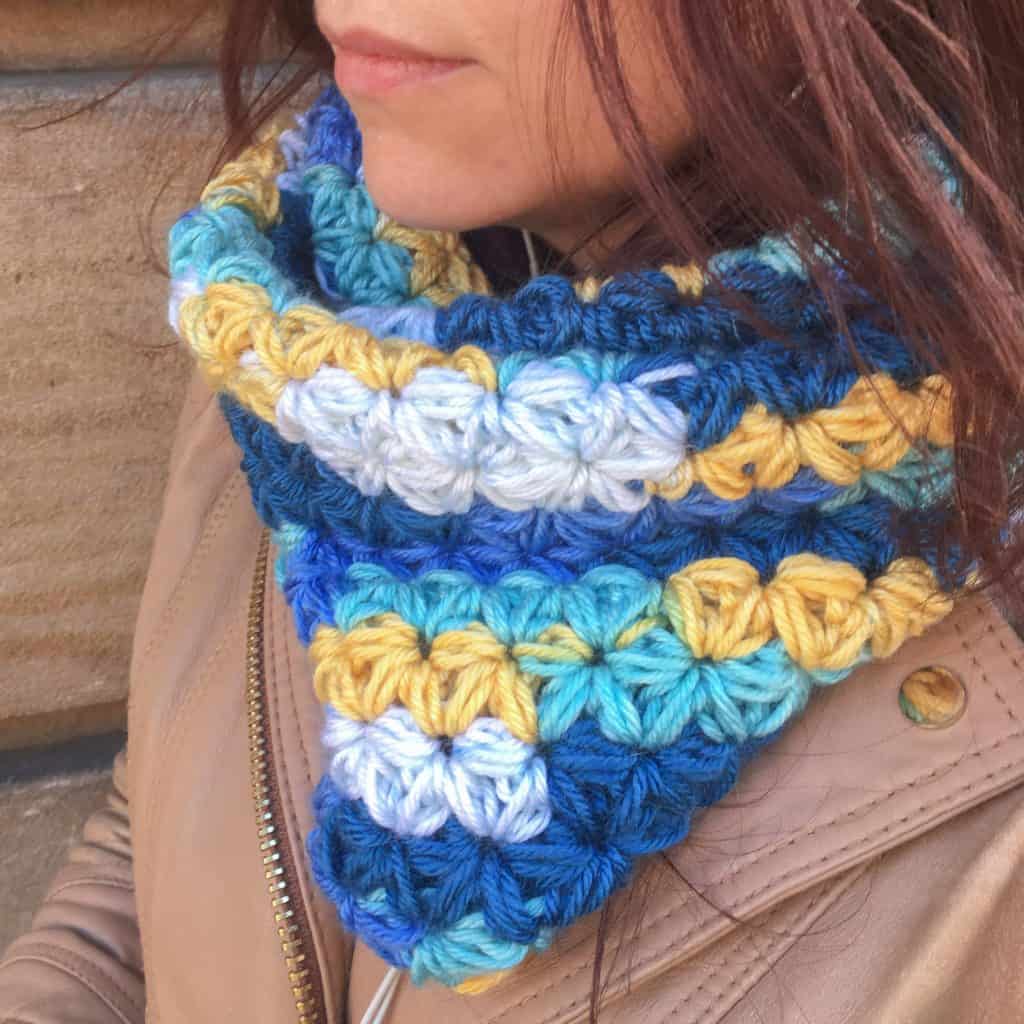
Crocheted infinity scarf vs cowl is another one where the distinction is blurry.
For me, an infinity scarf is a long loop of fabric worn around the neck that can be twisted (creating the infinity symbol) and worn as a double loop around the head.
If it’s too short to double up, then it’s a cowl. That’s the most practical way I have found to define the difference anyway. I am open to alternatives…
On an additional and slightly side note, it’s pretty easy to adapt a crochet infinity scarf pattern for a crochet cowl and vice versa, usually by just altering the circumference (taking into account stitch and row multiples and so forth). Indeed, one of the patterns in the round up offers two sizes to demonstrate this.
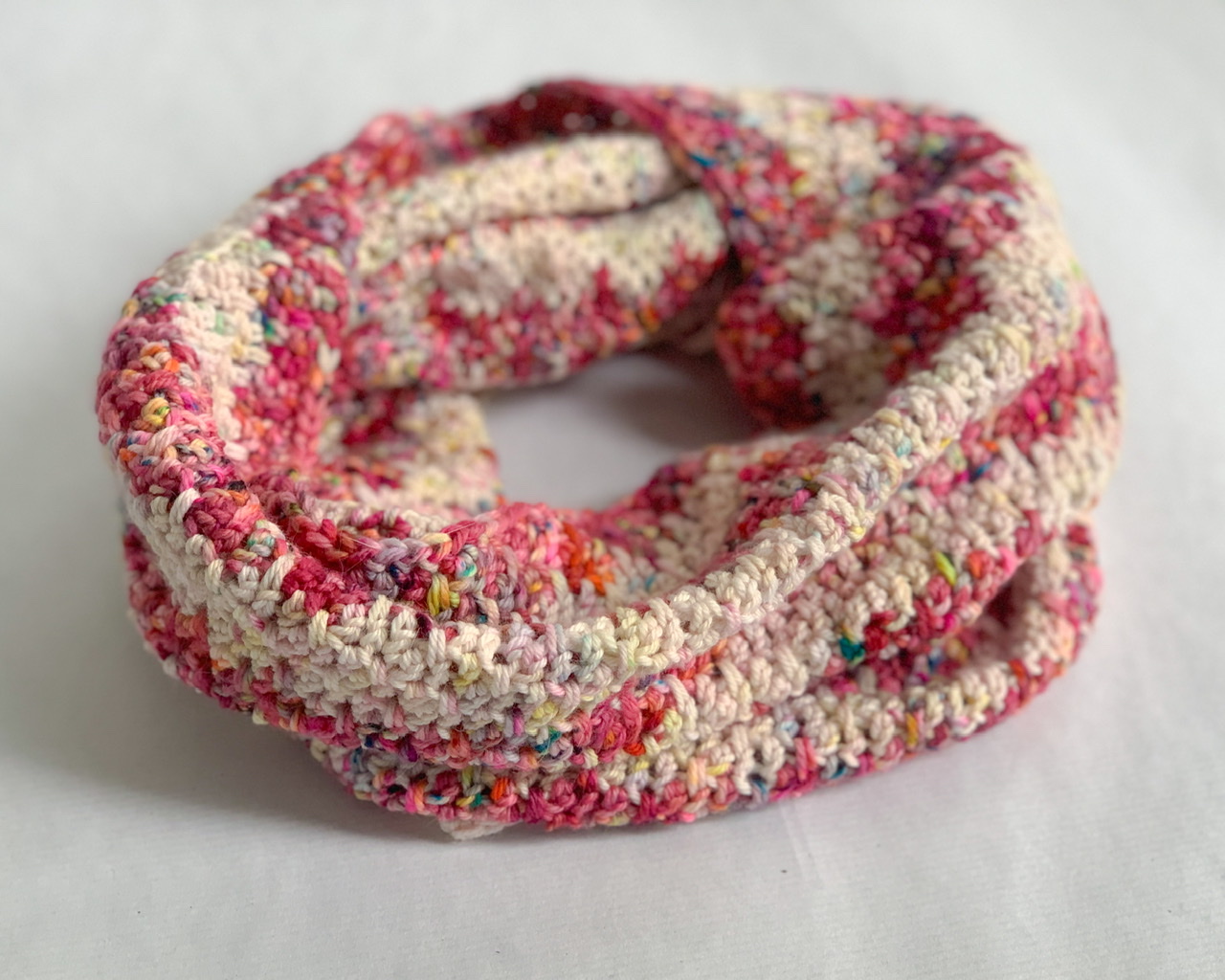
I also recently did this with my leap year infinity scarf pattern, shortening it to make the cowl you see as the header of the post, using some special hand dyed yarn from my stash.
I also came across the term ‘Wimple’ when researching cowls. It’s a great sounding word isn’t it, but I decided it was a step to far outside the lines to discuss further.
So lets just call a cowl a cowl…
The point of all these comparisons is that there doesn’t seem to be a simple, current universal definition for any of these terms. It’s all about context.
Words matter of course, but let’s try not to get too bogged down in semantics. What’s important here is that ‘we’ (crocheters, knitters, crafters etc.) all have the same understanding of the word.
So for the purposes of this post, I’ll use the term cowl to refer to a tubular accessory that is worn in a single loop around the neck for the purposes of warmth.
If I refer to a snood, I’m talking about a cowl that is deep enough to pull up over your head and wear as a hood. But I’ll largely stitch to cowl as a generic term.
Infinity scarves were discussed in my ‘all about scarves post’ so if that’s what you’re after, check that one out.

Why crochet a cowl?
I mean that question sounds a bit brutal written down so bluntly. But sometimes asking the basic questions makes all the difference to how you look at something.
Like a scarf, the principle function of a cowl is to keep your neck warm. Unlike a scarf, a cowl doesn’t have long tails flapping about and is less adjustable.
In terms of crocheting, cowls make great beginner projects as they are small with a simple construction which can be made with a huge variety of crochet stitches and yarn weights.
Because of their relatively small size, crochet cowls also make ideal last minute gift ideas. I mean they make good handmade gifts period, but if you’re short on time, then crocheting a cowl is a great place to start.
I see a lot of longer cowls that just sort of hang there, almost like an oversized statement necklace. These are likely worn more for how they look as a fashion accessory than for the purpose of keeping warm.
I like my cowls to be a cozy fit so they actually keep my neck warm. Long cowls might provide some warmth in milder weathers, but come winter, they are not for me. To each their own of course!
That said, I confess that I also sometimes wear cowls and infinity scarves kind of as grown up comfort blankets. There is just something about them that makes me feel a bit safe and secure (I’m aware this may just be a me thing).

What size should a cowl be?
For an adult size, the circumference of a cowl can measure from 50cm-100cm / 20in-40in.
Any longer than about 110cm / 44in and they start to cross the line into infinity scarf territory.
The depth of a crochet cowl can range from around 15cm-50cm / 6in-20in, or even more if you’re looking at including a hood functionality.
Other than personal preference and comfort, there really are no hard and fast rules when it comes to depth. But it’s worth noting that as your cowl gets deeper, the circumference will start to shrink. Not literally shrink, but will have less room in practical terms as you will need more space for the depth to gather comfortably around your head, neck and shoulders.
Whatever size you choose to make, always ensure that the cowl is comfortable. I love a snug cowl but it should never be even remotely uncomfortably tight.
Note that I only discuss adult size cowls in this post as I think cowls are unsuitable accessories for children or infants.
How is a crochet cowl made?
Crochet cowls can be constructed either as flat pieces or crocheted in the round (turned or unturned).
The easiest way to make a cowl flat is to simply crochet a rectangle, where the length represents the desired circumference and the width represents the desired depth. Then you simply seam the ‘depth sides’ together to create a loop.
The schematic below shows some different shapes and sizes of basic crochet cowls.

There are also different styles of crochet cowls, beyond the basic tube.
Some have off-set seams creating a triangle front, some have bibs on the front to extend to cover the neck, some bibs extend over the front and back (perfect for tucking under a jacket), some extend into mini-ponchos and cover the shoulders, some are tubular with added hoods.
The triangle front and bib cowl styles seem fairly popular in crochet circles at the moment and can be created quite simply.
Below I share two schematics, one showing how to construct a triangle front from a rectangle and one showing how a simple crochet triangle bib cowl is constructed. (I give some examples of these in the round up at the end of the post.)

What’s the best yarn to crochet a cowl?
Whenever choosing a yarn for a project, it’s important to think about the function of the item. This post goes into detail on the general guide to yarn selection.
When it comes to cowls, they are generally worn directly up against the skin, so using a fibre that is soft and not scratchy is important for comfort.
Whilst I love wools for warmth, some people have wool allergies or find it uncomfortable to wear, so an acrylic yarn may be more appropriate.
Others don’t like the feel of certain fibres like wool spun yarns or cotton, so choose something suitable for the recipient (whether that’s you or someone else).
Generally I avoid cotton for cold weather accessories because it has a tendency to hang on to water, which is not helpful in freezing climates… You can learn more about cotton as a fibre in this post.
What’s the best crochet stitch pattern for a cowl?
Once again, the type of stitch chosen should follow the function desired. If you want your cowl to be super warm, then choosing a cozy stitch is a good idea. If you want something light and airy, go for a more open stitch pattern.
Pretty much any crochet stitch pattern goes when it comes to cowls. What is important though is to have suitable drape in the fabric you create. You don’t want to feel like you’re wearing a neck collar or a cone of shame!
If you have found a stitch you love that’s a bit too reminiscent of cardboard, you can always try it with a larger hook size (or two).
You might like to look at my cosy stitch pattern round up or list of favourite opaque stitches for some ideas.
How long does it take to crochet a cowl?
As mentioned at the beginning, cowls can be a super quick make and some can even be made in less than an hour.
The time taken to make a cowl will depend on the yarn weight you are working with as well as the stitch pattern and density. But it’s not uncommon to be able to crochet a cowl in a single evening.
Crochet cowls can make great ‘palette cleanser’ projects to work between bigger, more involved crochet patterns such as a blanket or sweater.
As a rough guide, the ‘beginner bestie’ cowl seen at the start of the pattern round up below, uses worsted weight yarn and took me around 2.5 hours to crochet from start to finish. (It was about 3 and a half episodes of Grey’s Anatomy with some breaks!)
Cowls made with finer yarns and more complex stitch patterns or colour work will take longer. Cowls made with chunky yarn and simple open stitch patterns will take less time.

How much yarn do I need to crochet a cowl?
The quantity of yarn needed to crochet a cowl will depend on the specifics of the size and stitch pattern.
Cowls often use a relatively small amount of yarn and you could easily make one with less than 100g of yarn in most yarn weights.
Clearly if you’re making a larger cowl using a dense or ‘yarn-eating’ stitch pattern then you’re going to need more yarn.
If you’re a fan of stripes or colorwork, they can make brilliant stash-busting crochet projects and a great way to use up leftovers or part balls of yarn.
The beginner bestie cowl uses just under 100g of Aran weight yarn. I made it with with some yarn I had left over from the winter solstice dress. I clearly had a lot of part balls which past me had joined together with the magic knot to make into one larger ball.
Well, I think that cover’s the ‘all you need to know about cowls’ brief, so lets take a look at some free crochet cowl patterns as examples.
More ‘all about crochet’ style articles
12 free crochet cowl patterns with different stitches and construction styles
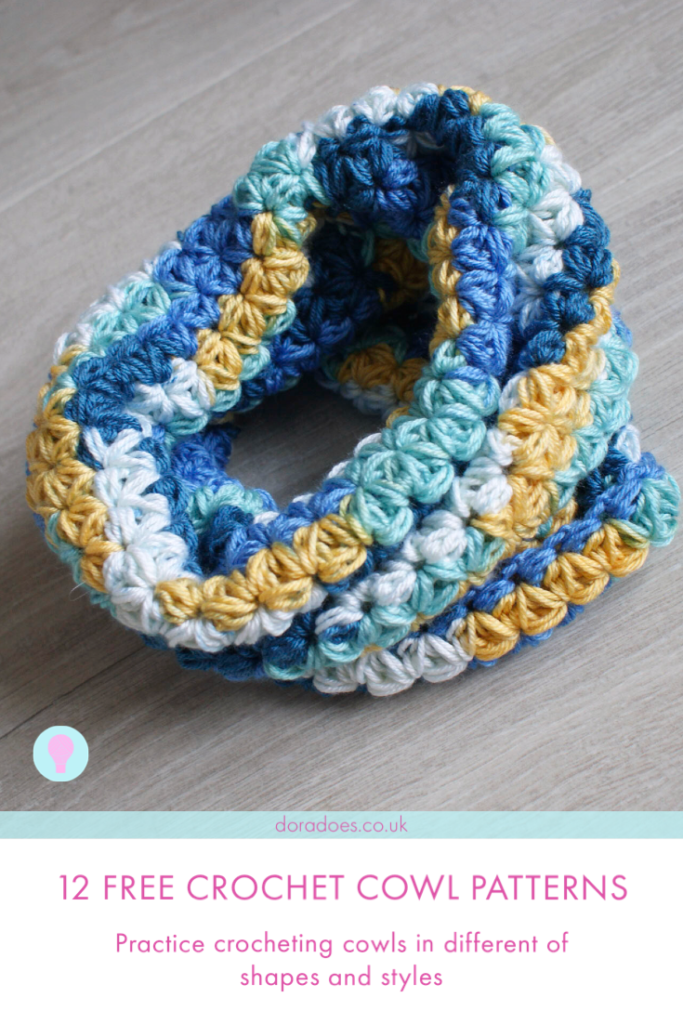
Below is a list of 12 free crochet cowl patterns which use a variety of construction styles, different stitches, fits and features which illustrate some of the aspects of crochet cowls discussed above.
There should be something here for every skill level, though mostly they are beginner to intermediate designs.
1. Beginner crochet cowl using simple stitches
‘Beginner bestie’ is my new easy crochet cowl pattern, designed especially to accompany this post. It is aimed at newer crocheters or those with more experience looking for a super easy pattern to relax with in front of the TV, in a waiting room or on a train.
This crochet cowl uses basic crochet stitches with an aran weight yarn. It is crocheted in turned rounds but the pattern also gives guidance on how to crochet it flat and seam it if that is your preference.
The stitch pattern on this one looks a little different on either side – I couldn’t decide which I prefer – so it’s a kind of 2 for one deal as well!
This cowl pattern was perfect for a recent autumn walk (snapped in the pic below whilst listening to my current audio book) and I think it will take me well into winter as well.
I also think it would look great crocheted in two colours… I might take my own advice and use some yarn from my stash to make an elegant simple gift with this pattern.

2. Super chunky one hour crochet cowl pattern
‘Chaucer twist’ is an easy cowl pattern, literally with a twist (though it can be made without), which takes around just 60 minutes to make using basic crochet stitches. This one is definitely for the lovers of chunky yarn and a quick project.
What started as an accidental twisting of a starting chain became a feature of cowl made long before I started publishing patterns. A friend of mine admired it so I made a version for her and wrote up the pattern to boot.
It is made using moss stitch (my all time fave), around 120g of super bulky weight roving merino yarn and a 12mm crochet hook. I have since made myself another version with stripes using multi-coloured left overs which I love for a simple no fuss throw on, goes with anything accessory.
This design is a snug fit, which I love, but the pattern includes instructions for increasing the size if you prefer something a little looser fitting.

3. Relaxed fit modern romantic crochet cowl
The Winter Blush crochet cowl pattern from a crocheted simplicity has a beautiful, interesting stitch pattern which creates a super cozy looking fabric.
The stitch pattern used is a variation of the extended moss stitch which I just know looks fabulous worked in two colours, so it would be fun to play with different colour combinations on this one.
This cowl measures 75cm / 30inches in circumference so is on the longer end of the size range, but still only uses one 100g skein of yarn (in worsted weight). On top of that, the pattern includes instructions to work this as an infinity scarf as well as a cowl, so you get twice the fun.

4. Unique textured cozy cowl
If you’re looking for something a bit different with a more unusual stitch pattern, then the Connected cowl might be for you.
This uses an original stitch pattern I designed that creates layers within the fabric, meaning it’s extra cozy and snuggly, perfect for keeping warm on cold days.
The pattern is much simpler to work than it looks and it’s hard to show in the photo how unusual and pleasing looking it is (if I say so myself).
This pattern can also be adapted to increase the size so is one for the confident crocheter to experiment with.

5. Three button lacy crochet cowl worked flat
The ‘Follow your path’ crochet cowl pattern from Made by Gootie is on the more lightweight side of the cowl spectrum with its lace stitch pattern. It has a lovely, almost herringbone texture with a light an open feel to it.
It uses a sport-weight yarn which adds elegance and drape to the design and the 3 button closure works really well with the slight chevron shapes.
Because this pattern is worked flat in a long rectangle, it is easy to continue crocheting until it reaches your desired length (circumference).

6. Extra thick, tall jasmine stitch cowl
I actually called this pattern the shifting sands snood, but if I stick to my cowl terminology as it’s probably just a little short to fall into my snood definition… But let’s not get distracted because, thanks to the stunning jasmine stitch with it’s thick, dense texture, this cowl extra warm and super cozy (and now used by my sister on her early morning winter dog walks).
If you’re interested in learning the Jasmine stitch, this pattern is a great project to practice on. It includes a link to a full jasmine stitch tutorial (which you can jump to here).
I’ll admit it’s a bit of a yarn eater, but it’s a very satisfying stitch pattern to crochet once you get going, so you will be ‘one more row’-ing from now until Christmas…

7. Hooded crochet cowl pattern with drawstring
I think that the Diosa hooded cowl pattern from Lulu stitch co is absolutely lovely. It uses fairly simple stitches (spoiler, it’s another moss stitch beauty) to create an elegant hooded cowl with lovely drape.
And those giant pom poms on the drawstring just make it.
Interestingly, the term ‘scoodie cowl’ is used to describe it in the post, just to throw a new term into the mix… (though I do talk about scoodies in my all about scarves post).

8. Generous puff stitch cowl made in the round
The peekaboo puff stitch cowl pattern from stitching together is a great example of how adding a feature stitch to a simple texture with a bit of colour contrast can create a modern and alluring accessory.
The image of this cowl just makes me want to snuggle up inside it! It looks so squishy and snug.
It’s a relatively straightforward pattern with additional advice on colour changes and detailed notes for areas that a some crocheters might find a challenge.

9. Fitted button-front tartan cowl pattern
I simply love the look of this tartan cowl pattern from the Loopy Lamb. The colourwork, the shape, the buttons, everything.
It uses the flat triangle construction technique showing in one of the schematics earlier on in this post, with the option to fold the top down to create a kind of collar (as shown in the picture below).
This kind of design requires a longer length fabric than the circumference, because of the overlap at the front (where the buttons are placed). This specific pattern also includes instructions for adjusting the size, so it’s one you can customise relatively easily.
On top of that, the design uses surface crochet, which is a great technique I encourage you to give a go if you haven’t so far. It’s much simpler than it looks and this pattern could be a great place to try it out. It really is a very pleasing stitch to work once you get in the zone.

10. Granny stitch triangle bib cowl
Is any round-up post complete without some granny stripe stitch popping up??
This ribbed granny stitch cowl from eye love knots is a nice example of a simple triangle bib pattern as shown in the earlier schematic.
The doubled over ribbing makes it cosy on the neck warmer side and the granny bib offers some extra light coverage over the upper chest. I can see this one working well tucked underneath a jacket for autumnal wanders.

11. Simple ribbed crochet cowl with unusual crossover join
I do love a ribbed neck-warmer, whether it’s a scarf or cowl or anything in between and the Ribbed crossover cowl from Blue star crochet is no exception.
On the one hand, it is a simple ribbed, close fitting cowl made flat. On the other it has a really interesting crossover style join which adds an interesting and unusual feature.
Seeing as I am always on the look out for interesting ways to modify simply constructed pieces, I had to share this one with you.

12. Practical over the shoulder cowl pattern
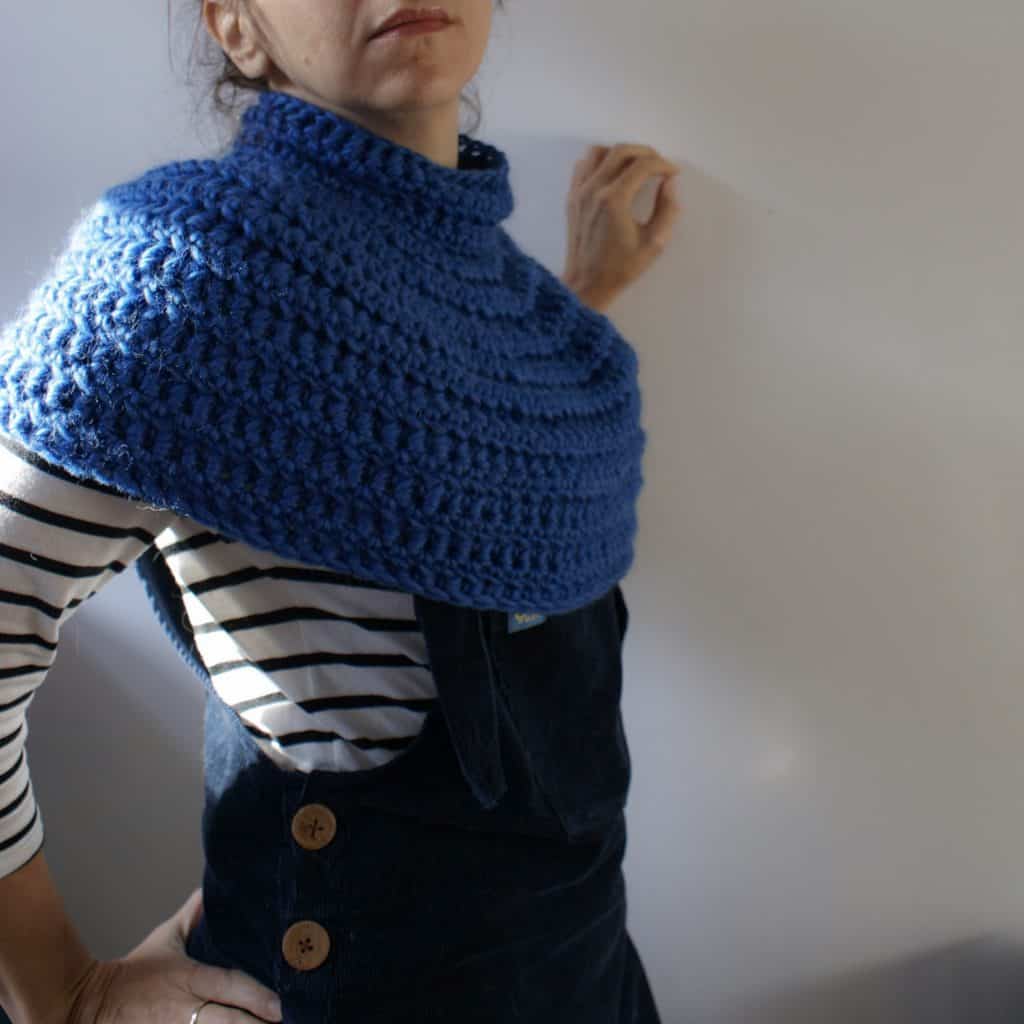
Last of all I want to share where my internal ‘what is a cow?l’ debate started. It was back when I designed what ended up calling the Practicowl. It was part chunky crochet cowl, part cosy caplet, part short poncho. Ultimately, it was designed to fit under a jacket easily so the important thing was that it is practical!
It’s crocheted using an interesting crossover type stitch and bulky yarn which makes it lovely and warm.
I confess that I actually wear this one around the house more than I do outside. I find it really useful for keeping me warm when sat working at my computer and doing my best not to put the heating on yet…
It’s a simple top down design which is worked in turned rounds. The crossover stitch might cause a little consternation to start with but once you get used to it you’ll be off and away!
So there we have it.
I hope you have found this post a useful round up of all things crochet cowl. Please do share it with your crochet friends if you think they will find it useful too.
In the meantime, if there’s anything you would still like to know about crochet cowls (or a new name you have for them that I can add to my list) then please do drop me a comment below.
Happy Hooking
Dx
More Crochet Scarf, Cowl and Shawl Patterns
Copyright Dora Does Limited, Registered in England, Company Number 13992263. This pattern is for personal use only and may not be shared or reproduced in written, photo, video or any other form without prior written consent. All rights reserved. Terms of service.
Note that images from third party designers were shared with their permission.


I am so glad that I found your blog, Dora. Your “deep dives” and resources are exactly what I needed to understand how crochet works in garments. I am a beginner (at 74), having knitted in the past but thinking that crochet will be easier with my arthritis. I came back to your blog to look for something I read earlier about the direction in which crochet tends to stretch and couldn’t find it again. I have garnered that many factors affect stretch, but the direction in which each stitch stretches more, would be very helpful to know.
Specifically, this relates to my wanting to make a cowl, a “snoody” one which I can stretch over my head. I run into two problems. First, that I want to make it out of a fine alpaca or merino “sport” wool, and virtually all cowl patterns are in heavier weights. So, since stitches will be smaller and I want to use a ‘tighter’ or denser stitch, I really need to know what direction the stitches will stretch more in. That will determine whether I crochet in the round (preferred) or flat. The second question is, “How can I alter a pattern given for one size of yarn to make it with a thinner yarn. I think that subject would be a great one for a future blog, don’t you?
Thank you for your wonderful website, blogs, and patterns!
Hi Freyda, thanks for the lovely feedback about the blog. I’m so glad that my style has resonated with you. With regard to your questions. Firstly in respect to stretch, generally speaking, crochet stretches more between rows than between stitches, but you’d need to swatch with the specific stitch pattern to be sure (You may have found this in my article about ribbing as I talk a lot about stretch there – but I like your suggestion of a stand alone post talking about it).
With regard to your second question about changing yarn weight. Again, to answer this, you start with swatching, and then with gauge. If you want to adjust a pattern for a different yarn weight, then basically (and this is very top line), you will need to swatch in the yarn you want to use, measure your gauge and then use those numbers to calculate the number of stitches you’ll need to work to achieve the same or your desired size – I have a post that will walk you through this process. It touches on a lot of the other factors involved to: https://doradoes.co.uk/2019/05/22/crochet-design-basics-how-to-use-gauge-to-crochet-to-measure-adjust-to-fit/
I hope that helps you keep on learning!
All the best
Dora
This is a lovely collection and I enjoyed the definitions at the top. Thank you! My suggestion for warm and soft yarn is 100% Merino wool. As an American living in Norway, I have gained a new appreciation for wool, both in how soft it can be and in how necessary it is in cold weather. Hope this is helpful for some.
Thank you – I love merino and am absolutely with you on this one! It’s super cozy and pretty robust when washed!