Maslow’s Rainbow Top CAL: Section 4 – Spaced Crochet Clusters

Here we are at part 4 for the Maslow’s Rainbow CAL. The time is flying! How did you get on with the granny dot stitch from part 3? I hope you enjoyed the combination of the two fun stitches and learned a little about the importance of belonging!
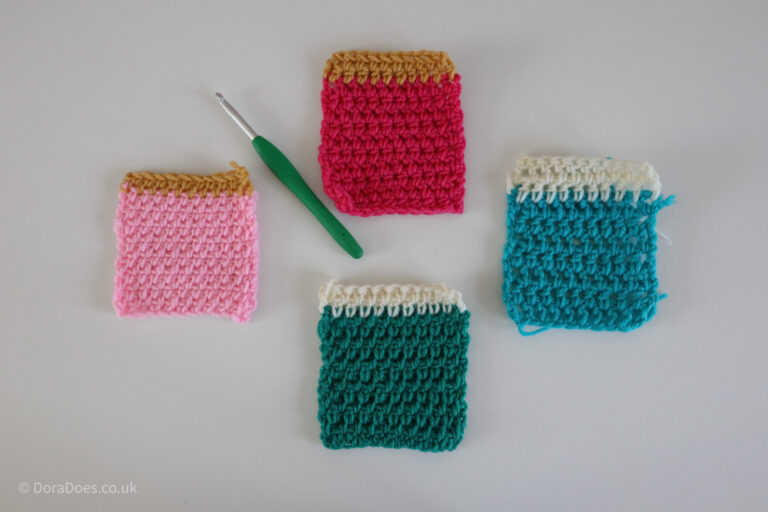
This week we are going to talk about the fourth layer of Maslow’s Hierarchy – Esteem needs, but first, here’s an unadulterated peek at my progress…

Esteem
Esteem is the second of the psychological needs (after Belonging) and is something we look for once the basic (physiology and security) needs have been met. As you might expect, esteem needs relate to self-esteem but also include self-respect, confidence, personal and social acceptance.
We can break these esteem needs into lower and higher needs. Lower is the need for validation and respect from others (and tends to be more important in childhood and adolescence) and Higher esteem needs relate to self-belief and acceptance which is the path to lasting healthy self-esteem.
We are fuelled by the desire to be accepted and valued by others, often looking externally for praise and validation. Social media is today’s villain in this respect. If we don’t get enough likes, shares or retweets we may believe this is a rejection of some form by our peer group. This is why it is so important to foster and nurture positive internal beliefs about our self-worth to ensure our psychological well being. If we have a strong internal sense of esteem then these external factors are likely to be less important and less damaging.
Where our esteem needs our not met, we can become filled with insecurity and feelings of inferiority. We can meet these needs by engaging in activities which give us a sense of achievement and fulfilment. That might be something as small as helping someone cross a road or working hard or as big as climbing Everest.
So, how have I worked that into this section of the CAL?
This week’s pattern is a spaced cluster stitch. It’s a simple stitch with clusters (you might call them bobbles) spaced evenly throughout the fabric. I want you to think of each bobble as a chance to boost your self esteem. Whether it’s internally thinking about something you like about yourself, or giving yourself a pat on the back for getting this far with the cal, or something more real like making a promise to do something which will make you feel good about yourself (a spa, or crafty class perhaps?). I genuinely think (and this is my opinion, not science) that so many of our problems today are directly related to rocky self-esteem. We work so hard on our bodies and appearances but we tend to neglect our esteem muscle – and it is a muscle – confidence needs to be practiced! So like these confident little cluster stitches standing out proud, get that self-worth muscle working!!
Pattern Notes
- This pattern is written in US terms (you can see a UK stitch conversion chart here)
- Turning chains do not count as stitches unless otherwise specified
- Instructions between *asterisks* should be repeated as indicated
Stitches & Abbreviations (US Terms)
ch = chain
st = stitch(es)
ss = slip stitch
dc = double crochet
sp = space
sk = skip
rep = repeat
rs = right side facing you
ws = wrong side facing you
cluster = cluster stitch (see special stitches below)
Special Stitches
Cluster Stitch (cluster)
Yarn over, insert hook, yo, pull up a loop, yo, pull through 2 loops (2 loops on hook), yo, insert hook into same stitch, yo, pull up a loop, yo, pull through 2 loops (3 loops on hook), yo, insert hook into same stitch, yo, pull up a loop, yo, pull through 2 loops (4 loops on hook),yo, insert hook into same stitch, yo, pull up a loop, yo, pull through 2 loops (5 loops on hook), yo, pull through all 5 loops, ch1 to close the stitch.
Clusters will be worked on rows where the WS is facing you. They should all ‘pop’ out on the same side.
Written instructions
Section 4: Esteem – In Green
Note, the rows below which use clusters are based on a multiple of 10. If your foundation row is not a multiple of 10 then, for the cluster rows only (the even numbered rows), add an equal number of stitches to the beginning and end of rows.
So for example, if your foundation row has 64 stitches, you will add 2 stitches to the beginning and end of the cluster rows (living you with 60 as the multiple of 10). If you have 78 stitches, you would add 4 rows to each end, leaving 70 as the multiple of 10.
Row 1: RS: Ch1, turn, sc in each st to end (50, 56, 62, 68, 74, 80, 86)

Row 2: Ch1, turn, work any additional sc here (see above) *sc in next 6 st, ch1, sk 1 st, cluster, ch1, sk1, sc*, rep * to end working any additional sc to end row
Row 3: Ch2, turn, dc in each st to end

Row 4: Ch1, turn, work any additional sc here (see above) *sc, ch1, sk 1 st, cluster, ch1, sk 1 st, sc in next 6 st* rep * to end, working any additional sc to end row
Row 5: Rep row 3

Row 6: Rep row 2
Row 7: Rep row 3
Row 8: Rep row 4
Row 9: Rep row 3
Row 10^: Rep row 2

Fasten off
^If you are working with a different yarn weight, repeat rows 7-9 until your section reaches 3-3.5in, finishing on a cluster stitch row

Below are the tutorials to help you with these stitches if you prefer to work from youtube!
Video Tutorials
Right Handed
Left Handed
This is a really fun stitch to work, and you know what, if some of your clusters aren’t perfectly spaced that is 100% okay – this is about learning and expressing yourself, not about being perfect. Perfect doesn’t exist, please try and think about that when you’re working on your own personal esteem!!
Don’t forget to share your progress on the weekly link in my facebook page (where you can also ask questions!) or share on Instagram too using #MaslowsRainbow hashtag.
I look forward to seeing how you get on. Next week we’ll move on to the final part of the cal – wow – that happened fast!!
Until next week then…
Happy Hooking
Dx