The Falling Pines Cabled Crochet Poncho
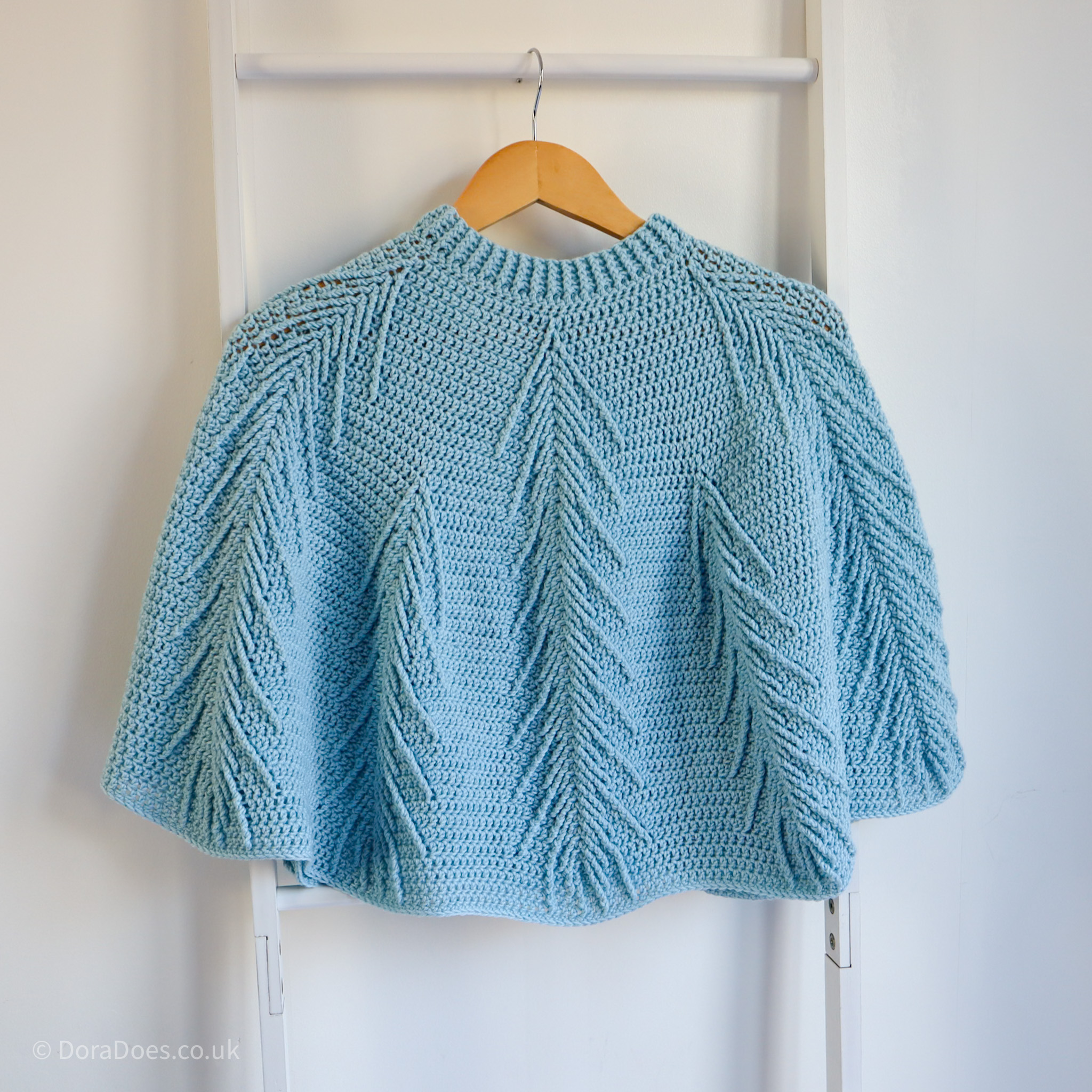
‘Falling Pines’ is a delicate, cabled, intermediate level crochet poncho pattern.
Inspired by the beauty of forrest Pine trees, this poncho is practical, wearable and pretty too. Now available in 3 sizes!
Not too chunky, but still warm and cosy, this crochet poncho can be worn as the nights get colder, thrown on for the early morning school run or snuggled up on in on the sofa on a lazy Sunday afternoon.
You can purchase the ad-free, PDF print friendly version of this pattern from: Ravelry, Etsy, or Love Crafts


This post contains affiliate links. This means if you click a link to a product and go on to make a purchase, I receive a small percentage of the sale at no extra cost to you. You can read my full affiliate disclosure here.




Before you get started, if you love the look of this design but poncho’s aren’t your thing, you might want to check out the Southern Pines Sweater – a round yoke, top-down sweater that uses the same motif.
Or if you’re looking for a smaller project to start experimenting with crochet cable patterns, why not try the Falling Pines Crochet Hat Pattern (with an ad-supported version that’s free to read or a PDF that’s available to purchase).
Pictured below, you’ll see what a dramatic set they make (crochet apes ski anyone?).

Click here for the Falling Pines Crochet Hat Pattern
Pattern Notes
General Notes
- Please read through the pattern and all associated notes before starting your project
- This pattern uses standard US crochet terms (UK equivalents are given in brackets in the abbreviations list)
- Numbers the end of a round indicate the number of stitches in that round and are only given at the start of a section or where there is a change
- Do not turn at the end of the round
- Chain 2 at the start of a round does not count as a stitch
- Unless otherwise indicated, stitches should be worked in consecutive stitches
- The first stitch of each round should be worked into the top of the first stitch from the previous round
- Instructions written after an *asterisk should be repeated as indicated
- Instructions written between [square brackets] should be worked the specific number of times instructed
- Instructions in (round brackets) should be worked in the same stitch
Construction
- This pattern is worked top-down in unturned joined rounds
- The pattern begins with 5(6, 7) ‘branches’ of the falling pines motif, and as the poncho increases over the course of the yoke, you will begin a second set, giving 10(12, 14) branches in total
- Once you have finished increasing, the pattern will use a 4 round repeat for the main body until the last few rounds
- The neckline is added at the end, with a choice of a cabled roll neck or a more classic ribbed neck trim.

Skill Level
- Knowledge of basic crochet stitches, techniques and terminology is assumed
- This is an intermediate level pattern
- Working in joined rounds without turning
- Increases and decreases
- Front post stitches – learn about front and back post stitches here
- Following written instructions including long stitch repeats
- Throughout the pattern, I have included some close-up images of the motifs to assist you – there is currently no photo or video tutorial for this pattern

Materials
Crochet Hook
You will need a 4.5mm crochet hook, or size needed to meet gauge.
I used my clover amour hook.
Yarn Requirements
Approximately 1120(1360, 1585)m / 1232(1496, 1744)yds of Double Knit (DK) yarn for sizes S(M, L) respectively.
The yarn used in the two pictured versions of the poncho is as follows:
Light blue ribbed neck version: Swish DK from We Crochet, 100% Superwash Merino Wool, 50g ball = 112m / 123 yds in Shade ‘Arctic’
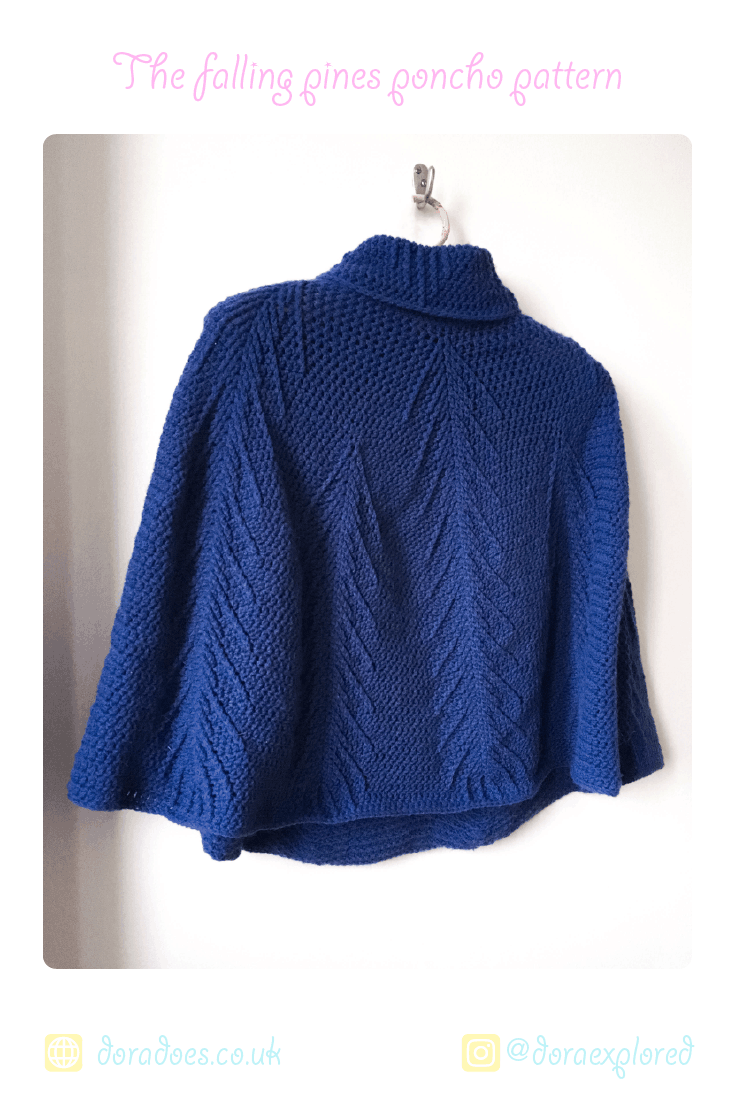
Darker blue roll neck (original) version: Rico Classic baby DK, 50% acrylic, 50% polyamide, 50g ball = 165m / 180yds in shade ‘Jeans’ (36)
Yarn Substitution options
Any similar dk yarns which meets gauge can be used for this pattern.
I encourage you to choose something with good stitch definition so that the cable motif pops. Different fibres and yarns will produce a different finished result.
You may find this post useful when choosing yarn.
Other Materials & Notions
Yarn needle, scissors and a tape measure
You may wish to block this project, in which case I recommend a blocking matt and pins. Learn more about blocking here.

How to purchase a Dora Does crochet pattern:
I sell my PDF crochet patterns in my Etsy, Ravelry and Love Crafts stores. You can purchase this pattern on any of these platforms, depending on your preference. Simply click the relevant links throughout this pattern page to be taken to the listing, or visit the store homepages in the links at the start of this paragraph.
Measurements sizes
- The poncho is designed for adults and is offered in 3 different sizes, Small, Medium and Large; S, M, L
- Approximate measurements of the finished garment after a gentle blocking are given below (based on the more recent light blue sample)
- Instructions for different sizes are written in increasing order, with the smallest size first and larger sizes following in brackets; S(M, L)
- Both items pictured here and in the pattern listing are a size Small
- The darker blue version is slightly longer – guidance is given in the pattern on how to change the length
Finished size
- Neck Circumference (cm): 54(64, 75)
- Chest Circumfernce(cm): 215(257, 300)
- Length (cm): 42cm for all sizes

Stitches & Abbreviations: US terms
(UK Equivalent in Brackets)
- bphdc = back post half double crochet (UK Raised Half Treble Back) – see special stitches
- ch = chain
- dc = double crochet (UK treble crochet)
- dc2tog = double crochet 2 together (UK treble 2 together) – see special stitches
- fdc = foundation double crochet (UK foundation treble) – see special stitches
- fptr = front post treble crochet (UK Raised Double Treble Front) – see special stitches
- fphdc = front post half double crochet (UK Raised Half Treble Front) – see special stitches
- RS = right side
- sc = single crochet (UK double crochet)
- st = stitch(es)
- ss = slip stitch
- WS = wrong side
- yo = yarn over
Special Stitches
Foundation double crochet (fdc)
Ch3, yo, insert hook into third chain from hook, yo and pull up a loop (3 loops on hook). *Yo and pull through 1 loop (this creates the base chain of the next fdc). Yo and pull through 2 loops (2 loops on hook), yo and pull through 2 loops to complete the st. To start the next st, yo and insert the hook into the v of the base chain you just created, yo and pull up a loop. Repeat from * for the number of stitches required.
You can find more details on foundation rows, including a tutorial here
Front post treble crochet (fptr)
This is worked just like a normal treble but instead of inserting the hook into the top of the stitch on the previous row, you insert it around the ‘post’ of the stitch so that the hook sits behind the post (the post is in front – which is where it gets it’s name). The post will pull towards you as you work to create the cable effect:
Yo twice, then, working from the front of the fabric, insert the hook behind the post of the indicated stitch (from front to back to front, so the post is in front of the hook), yo pull up a loop, [yo, pull through two loops] three times to complete the stitch.
You can find a tutorial for post stitches here
Double Crochet 2 Together (dc2tog)
Yo, insert hook, yo, pull up a loop (3 loops on hook), yo, pull through 2 loops (2 loops on hook), yo, insert hook into next stitch, yo, pull up a loop (4 loops on hook), yo, pull through 2 loops, (3 loops on hook) yo, pull through all 3 loops to complete the stitch.
For ribbed neckline option only:
Front Post half Double Crochet (fphdc)
Yo, insert hook behind the post of the stitch from the row below (from front to back to front, so the post is in front of the hook), yo, pull up a loop, yo, pull through all three loops.
The post will pull towards you as you work to create the cable effect.
Back Post half Double Crochet (bphdc)
Yo, insert hook in front the post of the stitch from the row below (from back to front to back, so the post is in behind the hook), yo, pull up a loop, yo, pull through all three loops.
The post will pull away from you as you work to create the cable effect.

Stitch Placement Notes
- This pattern contains an important increase at the centre of each ‘branch,’ where you will be instructed to work (2dc, fptr) in the same stitch (which will normally be a dc). In this instruction, you should work both of the 2dc into the top of the stitch and work the fptr around the post of the same stitch
- Throughout the pattern, front post trebles are worked into front post trebles from the previous round (except in the central increase as described above and at the start of the ‘branches’)
- Double crochets are worked into both dc and fptr
- On the next page I have shared some close up images which may help assist with the placement of stitches and show you what the finished branches should look like
Gauge
14 sts and 11 rows in 10cm of double crochet worked in unturned rounds using a 4.5mm hook or size needed to obtain gauge.
Variation in your gauge will lead to variations in the finished size of your project.
Learn how to make and measure a gauge swatch here.


You can purchase the PDF version of this crochet pattern from Ravelry, Etsy or Love Crafts
The Falling Pines Poncho Pattern
Below is a close up of what the pine branch motif looks like which you may find helpful when working the pattern.

The Pattern
Round 1 (RS): Make 75(90, 105)fdc, being careful not to twist the stitches, ss to top of first st to join, do not turn here or throughout. 75(90, 105) sts
Round 2: Ch2 (does not count as a st here or throughout), starting in the first st, [2dc in next st, 1dc in next 14 sts] 5(6, 7) times, ss to top of first st to join. 80(96, 112) sts
Round 3: Ch2, starting in the first st, [1dc, 2fptr in next st, 1dc in next 7 sts, 2dc in next st, 1dc in next 6 sts] 5(6, 7) times, ss to top of first st to join. 90(108, 126) sts
Round 4: Ch 2, starting in the first st, [1dc, 1fptr, (2dc, 1fptr) in next fptr, 1dc in next 15 sts] 5(6, 7) times, ss to top of first st to join. 100(120, 140) sts
Round 5: Ch2, starting in the first st, [1dc, 1fptr in next 2 sts, (2dc, 1fptr) in next dc, 1fptr, 1dc in next 15 sts] 5(6, 7) times, ss to top of first st to join. 110(132, 154) sts
Round 6: Ch2, starting in the first st, [1dc, 1fptr in next 3 sts, (2dc, 1fptr) in next st, 1fptr in next 2 sts, 1dc in next 15 sts] 5(6, 7) times, ss to top of first st to join. 120(144, 168) sts
Round 7: Ch2, starting in the first st, [1dc, 1fptr, 1dc, 1fptr in next 2 sts, (2dc, 1fptr) in next st, 1fptr, 1dc, 1fptr, 1dc in next 15 sts] 5(6, 7) times, ss to top of first st to join. 130(156, 182) sts
Round 8: Ch2, starting in the first st, [1dc, 1fptr, 1dc, 1fptr in next 3 sts, (2dc, 1fptr) in next st, 1fptr in next 2 sts, 1dc, 1fptr, 1dc in next 15 sts] 5(6, 7) times, ss to top of first st to join. 140(168, 196) sts
Round 9: Ch2, starting in the first st, [1dc, 1fptr, 1dc in next 2 sts, 1fptr in next 3 sts, (2dc, 1fptr) in next st, 1fptr in next 2 sts, 1dc in next 2 sts, 1fptr, 1dc in next 15 sts] 5(6, 7) times, ss to top of first st to join. 150(180, 210) sts
Round 10: Ch2, starting in the first st, [1dc, 1fptr, 1dc in next 2 sts, 1fptr in next 4 sts, (2dc, 1fptr) in next st, 1fptr in next 3 sts, 1dc in next 2 sts, 1fptr, 1dc in next 15 sts] 5(6, 7) times, ss to top of first st to join. 160(192, 224) sts
Round 11: Ch2, starting in the first st, [1dc, 1fptr, 1dc in next 3 sts, 1fptr, 1dc, 1fptr in next 2 sts, (2dc, 1fptr) in next st, 1fptr, 1dc, 1fptr, 1dc in next 3 sts, 1fptr, 1dc in next 15 sts] 5(6, 7) times, ss to top of first st to join. 170(204, 238) sts
Round 12: Ch2, starting in the first st, [1dc, 1fptr, 1dc in next 3 sts, 1fptr, 1dc, 1fptr in next 3 sts, (2dc, 1fptr) in next st, 1fptr in next 2 sts, 1dc, 1fptr, 1dc in next 3 sts, 1fptr, 1dc in next 15 sts] 5(6, 7) times, ss to top of first st to join. 180(216, 252) sts
Round 13: Ch2, starting in the first st, [1dc in next 5 sts, 1fptr, 1dc in next 2 sts, 1fptr in next 3 sts, (2dc, 1fptr) in next st, 1fptr in next 2 sts, 1dc in next 2 sts, 1fptr, 1dc in next 19 sts] 5(6, 7) times, ss to top of first st to join. 190(228, 266) sts
Round 14: Ch2, starting in the first st, [1dc in next 5 sts, 1fptr, 1dc in next 2 sts, 1fptr in next 4 sts, (2dc, 1fptr) in next st, 1fptr in next 3 sts, 1dc in next 2 sts, 1fptr, 1dc in next 19 sts] 5(6, 7) times, ss to top of first st to join. 200(240, 280) sts

Now you will begin a new branch after each existing one, so you will have 10(12, 14) in total.
Round 15: Ch2, starting in the first st, [1dc in next 5 sts, 1fptr, 1dc in next 3 sts, 1fptr, 1dc, 1fptr in next 2 sts, (2dc, 1fptr) in next st, 1fptr, 1dc, 1fptr, 1dc in next 3 sts, 1fptr, 1dc in next 10 sts, dc2tog, 2dc in next st, 1dc in next 6 sts sts] 5(6, 7) times, ss to top of first st to join. 210(252, 294) sts
Round 16: Ch2, starting in the first st, [1dc in next 3 sts, dc2tog, 1fptr, 1dc in next 3 sts, 1fptr, 1dc, 1fptr in next 3 sts, (2dc, 1fptr) in next st, 1fptr in next 2 sts, 1dc, 1fptr, 1dc in next 3 sts, 1fptr, dc2tog, 1dc in next 9 sts, 1fptr, (2dc, 1fptr) in next st, 1dc in next 6 sts] 5(6, 7) times, ss to top of first st to join. 220(264, 308) sts
Round 17: Ch2, starting in the first st, [1dc in next 6 sts, dc2tog, 1fptr, 1dc in next 2 sts, 1fptr in next 3 sts, (2dc, 1fptr) in next st, 1fptr in next 2 sts, 1dc in next 2 sts, 1fptr, dc2tog, 1dc in next 12 sts, 1fptr in next 2 sts, (2dc, 1fptr) in next st, 1fptr in next st, 1dc in next 6 sts] 5(6, 7) times, ss to top of first st to join. 230(276, 322) sts
Round 18: Ch2, starting in the first st, [1dc in next 5 sts, dc2tog, 1fptr, 1dc in next 2 sts, 1fptr in next 4 sts, (2dc, 1fptr) in next st, 1fptr in next 3 sts, 1dc in next 2 sts, 1fptr, dc2tog, 1dc in next 11 sts, 1fptr in next 3 sts, (2dc, 1fptr) in next st, 1fptr in next 2 sts, 1dc in next 6 sts] 5(6, 7) times, ss to top of first st to join. 240(288, 336) sts
Round 19: Ch2, starting in the first st, [1dc in next 4 sts, dc2tog, 1fptr, 1dc in next 3 sts, 1fptr, 1dc, 1fptr in next 2 sts, (2dc, 1fptr) in next st, 1fptr, 1dc, 1fptr, 1dc in next 3 sts, 1fptr, dc2tog, 1dc in next 10 sts, 1fptr, 1dc, 1fptr in next 2 sts, (2dc, 1fptr) in next st, 1fptr, 1dc, 1fptr, 1dc in next 6 sts sts] 5(6, 7) times, ss to top of first st to join. 250(300, 350) sts
Round 20: Ch2, starting in the first st, [1dc in next 3 sts, dc2tog, 1fptr, 1dc in next 3 sts, 1fptr, 1dc, 1fptr in next 3 sts, (2dc, 1fptr) in next st, 1fptr in next 2 sts, 1dc, 1fptr, 1dc in next 3 sts, 1fptr, dc2tog, 1dc in next 9 sts, 1fptr, 1dc, 1fptr in next 3 sts, (2dc, 1fptr) in next st, 1fptr in next 2 sts, 1dc, 1fptr, 1dc in next 6 sts] 5(6, 7) times, ss to top of first st to join. 260(312, 364) sts
Round 21: Ch2, starting in the first st, [1dc in next 6 sts, dc2tog, 1fptr, 1dc in next 2 sts, 1fptr in next 3 sts, (2dc, 1fptr) in next st, 1fptr in next 2 sts, 1dc in next 2 sts, 1fptr, dc2tog, 1dc in next 12 sts, 1fptr, 1dc in next 2 sts, 1fptr in next 3 sts, (2dc, 1fptr) in next st, 1fptr in next 2 sts, 1dc in next 2 sts, 1fptr, 1dc in next 6 sts] 5(6, 7) times, ss to top of first st to join. 270(324, 378) sts
Round 22: Ch2, starting in the first st, [1dc in next 5 sts, dc2tog, 1fptr, 1dc in next 2 sts, 1fptr in next 4 sts, (2dc, 1fptr) in next st, 1fptr in next 3 sts, 1dc in next 2 sts, 1fptr, dc2tog, 1dc in next 11 sts, 1fptr, 1dc in next 2 sts, 1fptr in next 4 sts, (2dc, 1fptr) in next st, 1fptr in next 3 sts, 1dc in next 2 sts, 1fptr, 1dc in next 6 sts] 5(6, 7) times, ss to top of first st to join. 280(336, 392) sts
Round 23: Ch2, starting in the first st, [1dc in next 4 sts, dc2tog, 1fptr, 1dc in next 3 sts, 1fptr, 1dc, 1fptr in next 2 sts, (2dc, 1fptr) in next st, 1fptr, 1dc, 1fptr, 1dc in next 3 sts, 1fptr, dc2tog, 1dc in next 10 sts, 1fptr, 1dc in next 3 sts, 1fptr, 1dc, 1fptr in next 2 sts, (2dc, 1fptr) in next st, 1fptr, 1dc, 1fptr, 1dc in next 3 sts, 1fptr, 1dc in next 6 sts sts] 5(6, 7) times, ss to top of first st to join. 290(348, 406) sts
Round 24: Ch2, starting in the first st, [1dc in next 3 sts, dc2tog, 1fptr, 1dc in next 3 sts, 1fptr, 1dc, 1fptr in next 3 sts, (2dc, 1fptr) in next st, 1fptr in next 2 sts, 1dc, 1fptr, 1dc in next 3 sts, 1fptr, dc2tog, 1dc in next 9 sts, 1fptr, 1dc in next 3 sts, 1fptr, 1dc, 1fptr in next 3 sts, (2dc, 1fptr) in next st, 1fptr in next 2 sts, 1dc, 1fptr, 1dc in next 3 sts, 1fptr, 1dc in next 6 sts] 5(6, 7) times, ss to top of first st to join. 300(360, 420) sts

You will now stop increasing and your stitch count will stay the same for the rest of the poncho. Each of the branches will now follow the same instructions so your instruction repeat will increase to 10(12, 14).
Round 25: Ch2, starting in the first st, [1dc in next 6 sts, dc2tog, 1fptr, 1dc in next 2 sts, 1fptr in next 3 sts, (2dc, 1fptr) in next st, 1fptr in next 2 sts, 1dc in next 2 sts, 1fptr, dc2tog, 1dc in next 8 sts,] 10(12, 14) times, ss to top of first st to join. 300(360, 420) sts
Round 26: Ch2, starting in the first st, [1dc in next 5 sts, dc2tog, 1fptr, 1dc in next 2 sts, 1fptr in next 4 sts, (2dc, 1fptr) in next st, 1fptr in next 3 sts, 1dc in next 2 sts, 1fptr, dc2tog, 1dc in next 7 sts,] 10(12, 14) times, ss to top of first st to join.
Round 27: Ch2, starting in the first st, [1dc in next 4 sts, dc2tog, 1fptr, 1dc in next 3 sts, 1fptr, 1dc, 1fptr in next 2 sts, (2dc, 1fptr) in next st, 1fptr, 1dc, 1fptr, 1dc in next 3 sts, 1fptr, dc2tog, 1dc in next 6 sts,] 10(12, 14) times, ss to top of first st to join.
Round 28: Ch2, starting in the first st, [1dc in next 3 sts, dc2tog, 1fptr, 1dc in next 3 sts, 1fptr, 1dc, 1fptr in next 3 sts, (2dc, 1fptr) in next st, 1fptr in next 2 sts, 1dc, 1fptr, 1dc in next 3 sts, 1fptr, dc2tog, 1dc in next 5 sts,] 10(12, 14) times, ss to top of first st to join.
Rounds 29 – 40: Rep Rounds 25-28
To increase the length of the poncho, repeat Rounds 25-28 more times. For a shorter poncho, work fewer repeats.
Round 41: Ch2, starting in the first st,*1dc in next 8 sts, 1fptr, 1dc in next 2 sts, [1fptr in next 2 sts, 1dc in next 2 sts] twice, 1fptr, 1dc in next 10 sts; rep from * to end, ss to top of first st to join.
Round 42: Rep Round 41
Round 43: Ch2, starting in the first st, *1dc in next 8 sts, 1fptr, 1dc in next 3 sts, 1fptr, 1dc in next 2 sts, 1fptr, 1dc in next 3 sts, 1fptr, 1dc in next 10 sts; rep from * to end, ss to top of first st to join.
Round 44: Rep Round 43
Round 45: Ch1 (does not count as a st), 1sc in each st to end, ss to top of first st to join
Fasten off and sew in ends

Neckline
You can choose either a cowl/roll neck option with cables or a classic ribbed collar style neck trim.
Roll neck option
Join yarn into back of the first st you worked in the Round 1 foundation row, with RS facing;
Round 1 (RS): Ch2, 1dc in each st to end, ss to top of first st to join. 75(90, 105) sts
Rounds 2-5: Rep Round 1
Turn your work
You will now be working on the WS as this part of the roll neck will fold over to the outside when worn.
Rounds 6-8 (WS): Ch2, 1dc in each st to end, ss to top of first st to join
Round 9: Ch2, starting in first st,*1fptr, [1dc, 1fptr] 3 times, 1dc in next 8 sts; rep from * to end, ss to top of first st to join
Rounds 10-11: Rep Round 9
Round 12: Ch2, starting in first st, *1fptr, [1dc, 1fptr] twice, 1dc in next 10 sts; rep from * to end, ss to top of first st to join
Round 13: Rep Round 12
Round 14: Ch2, starting in first st, *1fptr, 1dc, 1fptr, 1dc in next 12 sts; rep from * to end, ss to top of first st to join
Round 15: Rep Round 14
Round 16: Ch1, 1sc in each stitch to end, ss to top of first st to join
Fasten off, block as needed and sew in ends
To increase the length of the roll neck you could work more rounds before you turn your work and more after you turn it, working the additional rounds as dc only.
Ribbed neckline option
Join yarn into back of the first st you worked in the Round 1 foundation row, with RS facing;
For sizes S and L only;
Round 1 (RS): Ch2, 1dc in each st to last st, 2dc in last st, ss to top of first st to join. 76(0, 106) sts
For size M only
Round 1 (RS): Ch2, 1dc in each st to end, ss to top of first st to join. 0(90, 0) sts
For all sizes;
Round 2: Ch1 (does not count as st), starting in first st, *1fphdc in next st, 1bphdc in next st, rep from * to end, ss to top of first st to join. 76(90, 106) sts
Rounds 3-6: Rep Round 2
Fasten off, block as needed and sew in ends

Please contact me with any questions on the pattern! I hope you enjoy making it, and as always, don’t forget to tag me in your finished makes! Nothing makes me happier than seeing my designs brought to life by others. I love the colour choices and personal touches you add to the patterns!
Want to take the next step from this pattern – check out the Southern Pines Crochet Sweater Pattern which uses the same cabled motif.

How to find me and share your finished makes
- On Instagram, you can use the hashtag #DoraDoes to share your finished projects or just tag me @doraexplored
- If you have the bug for creating garments, why not join my dedicated facebook group “My Crochet Wardrobe” and share them there?
- Sign up to the WiP Tip for weekly crochet chat, offers and exclusives straight to your inbox – click here to sign up.
Happy Hooking
Dx

Copyright Dora Does Limited, Registered in England, Company Number 13992263. This pattern is for personal use only and may not be shared or reproduced in written, photo, video or any other form without prior written consent. All rights reserved. Terms of service.